
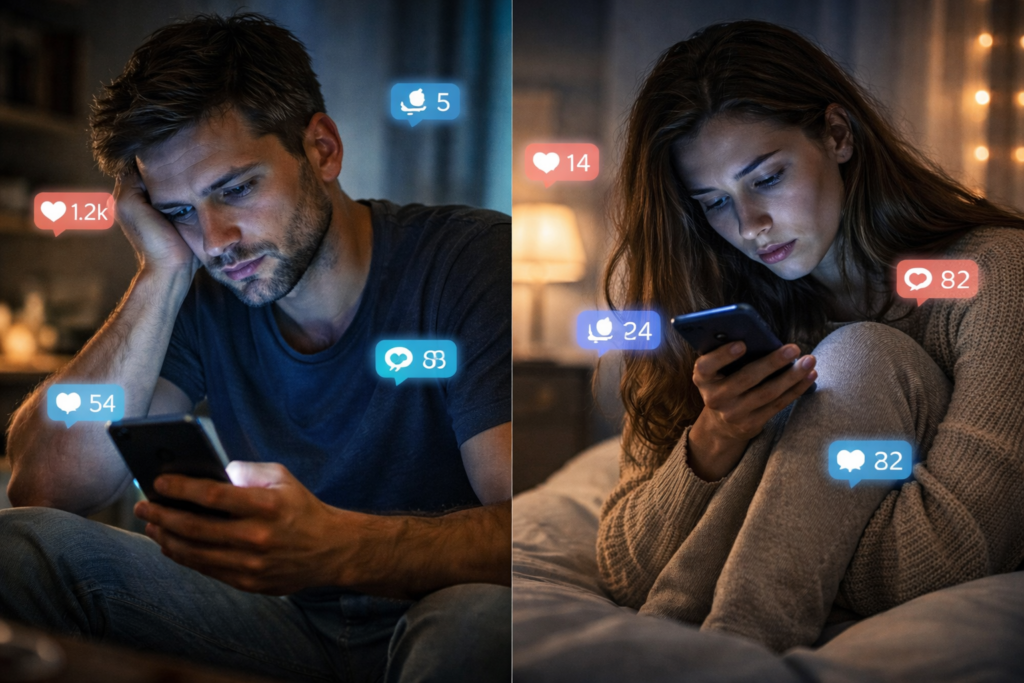
“If you need an audience to feel alive, you’ll feel lonely the moment the screen goes dark.”
– Wellness Kraft
Introduction
You can have 1,200 followers, 47 group chats, a streak going with someone you barely know, and still feel like you’re standing alone in a crowded elevator where nobody makes eye contact.
That’s the weird modern loneliness: you’re surrounded by signals, but starving for connection.
And it’s confusing because social media looks like social life. It uses the same ingredients: faces, jokes, stories, reactions, “thinking of you,” birthday reminders, hearts, comments, a constant low-level buzz of human activity. But sometimes it functions like sugar water. It tastes like connection, it lights up the brain for a second, and then you’re left thirstier than before.
If you’ve ever closed an app and felt a quiet drop in your chest, like your day got colder for a moment, you know what I mean.
Let me paint a real-life scene that happens everywhere now:
A person comes home after a long day. They’re not in a dramatic crisis. They feel… unheld. They open Instagram or TikTok “for five minutes.” They see friends laughing at a café—a couple on vacation. A colleague announces a promotion. Someone’s perfect home. Someone’s ideal body. Someone’s perfect friend group. They scroll faster, searching for something that makes them feel included. They find a funny video and laugh. For ten seconds, they feel better.
Then the laughter ends.
Their thumb keeps going, but their mood starts slipping. The brain turns into a comparison machine: “Everyone’s doing something. Everyone’s invited somewhere. Everyone is progressing.” They check their DMs. No new messages. They refresh. Still nothing. They put the phone down, and suddenly the room feels louder with silence.
That’s not “being dramatic.” That’s a system doing what it’s trained to do: look for belonging, measure status, scan for safety, and interpret absence as rejection.
Here’s the hard truth that actually helps:
Social media doesn’t create loneliness out of nothing. It often amplifies what’s already there and then offers a loop that keeps you stuck.
The loneliness loop (the one most people don’t notice)
- You feel lonely or stressed.
- You open social media for comfort and distraction.
- You consume other people’s highlight reels and social proof.
- You compare, you withdraw, you feel “behind” or “outside.”
- You feel lonelier.
- You return to social media because real life now feels harder to enter.
And because the loop still contains humans and content and laughter, your brain keeps believing it’s the solution.
It’s like standing at a buffet where everything looks delicious, but none of it nourishes you.
Why does it hit harder than we admit
Because loneliness isn’t just “I don’t have people.” Loneliness is often:
- “I don’t feel truly seen.”
- “I don’t feel safe being myself.”
- “I don’t feel chosen.”
- “I don’t feel like I matter to anyone right now.”
Social media is incredible at showing you proof that people exist, but not always great at making you feel you belong to them.
The difference between connection and contact
Contact is: likes, views, notifications, quick replies, comments, and being “in the loop.”
Connection is: being known, being understood, being able to speak without performing, feeling emotionally held, feeling real.
A lot of people are drowning in contact and dehydrated of connection.
How social media quietly isolates you (without you noticing)
1) It turns friendship into performance.
When everything becomes “postable,” your brain starts editing your life in real-time. You’re not just living moments, you’re packaging them. And the more you package, the less you feel. Performing is exhausting. Exhaustion makes you withdraw.
2) It creates a permanent comparison window.
In real life, you compare sometimes. Online, you compare constantly. And you compare your behind-the-scenes to everyone’s best scenes. Even if you know it’s curated, it still lands emotionally like evidence.
3) It replaces “third places.”
Humans used to have casual connection spaces: parks, chai shops, clubs, community gatherings, neighbor conversations, and little rituals. Many of those have shrunk. Social media fills the gap, but often through passive consumption rather than two-way bonding.
4) It rewards quantity over quality.
Your brain gets trained to crave “more”: more followers, more engagement, more content, more novelty. But belonging comes from depth, not volume.
5) It can turn silence into a threat.
If your nervous system starts using notifications as proof that you matter, then no notifications can feel like proof that you don’t.
Now for the part that’s actually empowering: this is not a “you problem.” It’s a design problem meeting a human brain that evolved for tribes, not feeds.
And you can redesign your relationship with it without deleting your entire online life.
Here’s a simple interactive check-in before we go further:
When you use social media, do you usually feel more connected afterward, or more hollow?
Not what you intended. What actually happens.
That answer tells you what you’re dealing with.
Research Insight
What the research broadly suggests
Researchers and public health organizations increasingly treat loneliness and social isolation as serious health and well-being issues, not just “sad feelings.” The big picture across many studies is that social connection supports mental and physical health. At the same time, chronic loneliness and isolation are associated with higher risks for poor outcomes (mood issues, sleep problems, stress, and broader health risks).
On social media specifically, the evidence often points to something nuanced that people rarely talk about: it’s not only about how many hours you spend online. It’s also about how you use it.
- Passive use (scrolling, lurking, consuming without interacting meaningfully) is more likely to be linked with negative feelings like loneliness, envy, and lower mood for many people.
- Active, meaningful use (direct messaging, supportive comments, honest conversations, community participation) can feel more socially nourishing, especially when it leads to authentic relationships or genuine support.
- Individual factors matter a lot. If someone is already lonely, anxious, depressed, or socially stressed, they may be more vulnerable to feeling worse after certain kinds of social media use.
- Some studies suggest that reducing social media use or taking short “detox” breaks can improve well-being for some people, but results can vary by person and context.
The most practical takeaway is this: the goal isn’t “social media is bad.” The goal is to reduce the parts that mimic connection and increase the parts that create real connection.
Sources
- U.S. Surgeon General Advisory (2023): Our Epidemic of Loneliness and Isolation (hhs.gov)
- Office of the Surgeon General: Social Connection resources (updated 2025 page) (hhs.gov)
- APA: Health advisory on social media use in adolescence (APA)
- Peer-reviewed (2023): Associations between social media use and loneliness (full text) (PMC)
- Pew Research Center (2025): Teens, social media and mental health (Pew Research Center)
- JAMA Network Open (2025): Social media detox and youth mental health (study) (JAMA Network)
If you want these to auto-click in WordPress, paste the raw URLs on separate lines inside your post editor (not a code block). The URLs above are the same, just formatted to be clickable in chat.
Key Takeaways
- Loneliness can grow even when you’re constantly “connected” because contact is not the same as connection.
- Social media can amplify loneliness through comparison, performance pressure, and passive consumption.
- The “loneliness loop” is real: lonely → scroll → compare → withdraw → lonelier → scroll.
- Your outcome depends heavily on how you use social media: passive scrolling tends to drain, meaningful interaction tends to nourish.
- You don’t need to quit the internet to feel better. You need a better connection strategy than “scroll and hope.”
FAQs
1) Why do I feel lonely even when I talk to people online all day?
Because your brain is not counting messages, it’s measuring meaning. You can exchange hundreds of short signals and still not feel emotionally held. Most social apps encourage quick reactions, not deep presence. A “haha” and a fire emoji are social, but they’re not always intimate. Intimacy usually requires time, vulnerability, and the feeling that someone actually knows what’s going on in your head, not just what you posted.
A helpful question is: Do I feel understood after I log off?
If the answer is “not really,” then what you’re getting is social stimulation, not relational comfort.
2) Is social media causing loneliness, or are lonely people just using it more?
Often, it’s both. People who already feel lonely may use social media more to cope or to find a sense of belonging. At the same time, specific patterns of use, especially passive scrolling and constant comparison, can worsen loneliness. That creates a feedback loop where loneliness increases reliance on the very thing that is not entirely solving it.
Instead of asking, “Is it the cause?” ask: Is it helping me or hurting me lately?
That question gives you power immediately.
3) Why does scrolling sometimes feel good in the moment but worse afterward?
Because scrolling can temporarily numb discomfort with novelty, your brain gets quick hits of new content, humor, or distraction, and for a moment, your emotional pain quiets down. But when you stop, the original loneliness is still there, plus a new layer: comparison, time loss, and the feeling that you didn’t actually receivea real connection.
It’s like chewing gum when you’re hungry. Your mouth is busy, but your body still needs food.
4) What’s the difference between healthy and unhealthy social media use?
A simple test: Does your use move you toward people, or away from people?
Healthier use often looks like:
- messaging a friend directly
- joining a supportive community where you participate, not just watch
- using it to set up real calls, meetups, collaborations
- Consuming content that helps you, not content that triggers comparison or shame
Unhealthier use often looks like:
- endless passive scrolling
- checking likes for self-worth
- following people who make you feel “less than.”
- using it to avoid life rather than enrich life
5) What can I do today if I feel lonely but don’t want to burden anyone?
First, you are not a burden for wanting connection. That’s a human need, not a personal failure. But if you want something easy and low-pressure, try this “small-door” approach:
- Send one message that doesn’t demand a significant response:
“Hey, no need to reply fast. Just wanted to say I was thinking of you.” - Or ask for a tiny connection, not a dramatic conversation:
“Got 10 minutes for a quick call later?” - Or do a “shared moment” message:
“This reminded me of you” (plus a photo or meme).
The goal is not a deep confession. The goal is to create a thread back to real human contact.
Concluding Thoughts
Loneliness in the social media age has a particular flavor. It’s not always the loneliness of having nobody. It’s the loneliness of feeling unseen while being visible.
And that can mess with your head because it makes you ask the wrong question: “What’s wrong with me?”
When the better question is: “What kind of connection am I actually getting?”
You don’t need a perfect life or a huge friend group to feel connected. You need a few places where you can show up without performing. A few people who feel safe. A few routines that bring you back to real life, not just the feed version.
If you want a practical “starting move” that doesn’t require motivation, try this for one week:
- Reduce passive scrolling by 10 minutes a day.
- Replace it with one active connection: one DM, one voice note, one call, one walk with someone, one hello to a neighbor, one short community activity.
Not because social media is evil.
Because your nervous system deserves proof that connection is still real, still available, still close enough to touch.




Join the conversation