
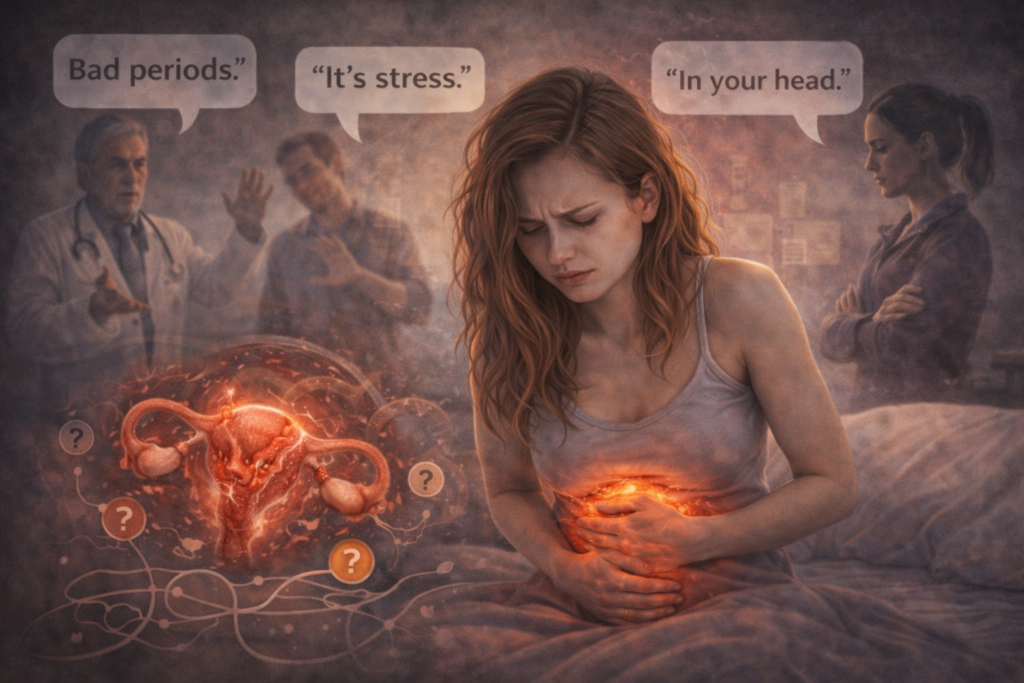
“Pain that steals your life is not a normal period. It’s a signal.”
– Wellness Kraft
Introduction
Endometriosis is one of those conditions that can make you look perfectly okay while your inside world is chaos.
From the outside, people see you still showing up: work, classes, family plans, social events. From the inside, you’re doing the math every month. The kind of math nobody applauds:
- “If I go today, will I crash tomorrow?”
- “If I eat this, will my stomach punish me later?”
- “If I say yes, will I be stuck in pain halfway through?”
- “If I take painkillers now, will they even work in two hours?”
And because you’ve been forced to “handle it,” you start shrinking the truth. You edit your pain so you won’t sound dramatic. You call it “discomfort” when it’s actually a knife-like ache. You say “I’m fine” because explaining it feels exhausting.
That’s where the long diagnostic delay begins: not only in the healthcare system, but also in the way many women learn to downplay what’s happening in their bodies.
Let’s make this simple and honest:
Endometriosis doesn’t just cause pain. It causes doubt. And doubt can steal years.
Quick check-in (answer in your head):
When you describe your symptoms to someone, do you give the clean version… or the real version?
Because the real version matters.
What Endometriosis Is (In Simple Words)
Endometriosis is when tissue similar to the lining of the uterus grows outside the uterus. This tissue can respond to hormonal changes, triggering inflammation, scarring, and pain. It most often affects the pelvic area, but it can also involve bowel, bladder, and, more rarely, areas beyond the pelvis.
The result isn’t just “bad cramps.” For many women, it can be a whole-body experience: pelvic pain, fatigue, heavy bleeding, bowel issues, pain during sex, bloating, nausea, and a sense that your body is working against you.
And the frustrating part is: it doesn’t always look the same from one person to another. Some women have intense pain with minimal visible disease. Others have extensive disease with less pain. That mismatch is one reason people get dismissed.
Why It Still Takes Years
If you’ve felt like you’ve been circling appointments without landing on a clear answer, you’re not imagining it. Endometriosis diagnosis is often delayed for years, and it’s usually not one single mistake. It’s a stack of barriers.
1) Menstrual pain is over-normalized
Many girls grow up hearing: “Periods hurt. Welcome to womanhood.”
So they tolerate more than they should. They miss school. They faint. They vomit. They curl into a ball. And still they wonder if they’re just “weak.”
Here’s the line that matters:
Pain that disrupts your life is not something you have to accept as usual.
If you’re missing work or school, if you can’t stand upright, if you’re planning your life around pain, your body is not being “dramatic.” It’s sending a signal.
2) Symptoms overlap with other conditions
Endometriosis can look like:
- IBS (bloating, constipation, diarrhea)
- recurrent “UTI-like” feelings
- ovarian cyst pain
- pelvic inflammatory issues
- musculoskeletal back or hip pain
- anxiety (because living with unpredictable pain creates anxiety)
It’s easy for both patients and clinicians to chase the wrong thread, especially when bowel symptoms are loud or when pain is described as “stomach problems” instead of pelvic problems.
A clue many women notice later: symptoms that worsen around the menstrual cycle, or pain patterns that feel cyclical even when they’re not perfectly predictable.
3) There’s no simple “one test” that confirms it
Many people expect a clear lab test: positive or negative.
Endometriosis doesn’t usually work like that.
Imaging can sometimes detect certain forms (like ovarian endometriomas or deep disease), but it can also miss other forms. That means a “normal scan” can falsely reassure people and slow the pathway to answers.
Historically, the most definitive confirmation has been surgical visualization (often laparoscopy), sometimes with tissue confirmation. Surgery is not a casual step, which can create delays, especially if someone keeps being told to “wait and see.”
4) The treatment loop can hide the diagnosis problem
A common pathway looks like this:
pain meds → hormonal birth control → “let’s see” → switch pill → “let’s see” → repeat
Hormonal treatments can genuinely help many women, and they’re often used early because they’re accessible. But symptom improvement doesn’t always equal clarity. And if symptoms persist, worsen, or limit your life, “try another pill” shouldn’t be the end of the conversation.
5) Women get trained to become “credible patients.”
This is the quietest and most painful one.
Many women learn that if they look upset, they’re labeled emotional. If they insist, they’re labeled difficult. So they try to sound calm, logical, “reasonable.”
But the cost is that they sometimes underreport how bad it truly is.
You shouldn’t have to perform calmness to receive care.
A Story Many Women Recognize
Rachel is 27. She’s competent, dependable, and the kind of person who pushes through.
Her pain started in high school. On some period days, she’d lie on the bathroom floor because it felt safer than standing. She missed classes, but she also felt embarrassed about it. Adults around her called it “bad cramps,” like it was an annoying weather pattern.
In college, it got more complicated. She started noticing bowel pain during her period. Some months, she’d be constipated for days, then suddenly get cramps and diarrhea. She’d Google foods, blame gluten, blame dairy, blame stress. She saw a doctor who suggested IBS. Another suggested anxiety. Someone told her to “exercise more.”
Rachel learned to soften her words. She stopped saying “sharp pain.” She started saying “pressure.” She stopped saying “I can’t function.” She started saying, “I’m uncomfortable.”
Then there was sex. She loved her partner, but deep pain made her tense up. She didn’t want to ruin the mood, so she ignored it until she couldn’t. She started avoiding intimacy. She felt guilty. She felt broken. Nobody had warned her that pelvic pain could be tied to her cycle and still be real, serious, and treatable.
Years passed. Rachel didn’t suddenly get worse. She ran out of the ability to carry it quietly.
At one appointment, a clinician asked better questions:
- “Does the pain start before bleeding and linger after?”
- “Is it worse around your period?”
- “Any pain with bowel movements?”
- “Any deep pain with sex?”
- “What do you miss because of this?”
Rachel cried, not because she was fragile, but because someone finally made her feel understood.
That shift matters. Because for many women, the most significant delay isn’t the lack of information. It’s the lack of being believed.
Symptoms That Deserve Serious Attention
Not everyone has the same pattern, but these are common “don’t brush it off” signs:
- period pain that interferes with daily life
- pain that begins before bleeding and lingers after
- deep pain during sex
- bowel symptoms that flare around your period (pain, constipation, diarrhea, rectal pain)
- Bladder pain that worsens around your period
- chronic pelvic pain outside of periods
- heavy bleeding plus fatigue
- infertility or difficulty conceiving
- “endo belly” bloating that makes you feel swollen and uncomfortable
Even if you don’t have all of these, one or two of them with substantial life disruption is enough to seek evaluation.
How to Advocate for Yourself (Without Turning Into a Medical Expert Overnight)
You don’t need to know every term. You need a more straightforward way to communicate what’s happening.
1) Track patterns for 2–3 cycles
Keep it simple:
- pain score 0–10
- location (pelvic, back, rectal, bladder)
- timing (before period, during, after)
- triggers (sex, bowel movements, walking, sitting)
- what you miss (work, school, sleep, social plans)
- what meds you took and if they helped
This turns your story from “I hurt sometimes” into “Here is a pattern.”
2) Speak in “impact” language
Doctors are trained to respond to function.
Instead of: “It hurts.”
Say:
- “I miss work/school monthly.”
- “I can’t stand upright on day 1–2.”
- “I’m taking pain medication regularly, and it’s not enough.”
- “Sex is painful enough that I avoid it.”
- “My bowel/bladder pain flares with my cycle.”
You’re not being dramatic. You’re being specific.
3) Ask direct questions
Try:
- “Could this be endometriosis?”
- “What else could explain cyclical pelvic pain like this?”
- “What can imaging show, and what can it miss?”
- “If symptoms continue, when would referral to an endometriosis specialist make sense?”
4) Don’t let a routine scan end the conversation if your life is still disrupted
This is big: imaging can be helpful, but it doesn’t always rule endometriosis out. If your symptoms are severe and persistent, you deserve a plan, not a shrug.
5) Consider the value of specialist care
Not every clinician has extensive training in deep endometriosis. A specialist or a clinic experienced in pelvic pain can shorten the road, especially if your symptoms are complex or you’ve been dismissed repeatedly.
Treatment Options (Realistic Overview)
Treatment isn’t one-size-fits-all. It’s often layered and built around your goals: pain relief, quality of life, fertility plans, and long-term management.
Common categories include:
- Pain management (medications and non-medication approaches)
- Hormonal therapies (often used to reduce symptoms for many women)
- Surgical approaches in some cases (especially when symptoms persist or disease patterns suggest benefit)
- Pelvic floor physical therapy if muscle tension and pelvic floor dysfunction are contributing
- Fertility-focused care if pregnancy is a goal and conception is difficult
- Mental health support when chronic pain has created anxiety, depression, or trauma-like stress (because living with pain changes the brain and nervous system)
The goal is not just “make the pain tolerable.”
The goal is “give you your life back.”
Research Insight
Endometriosis is recognized as a chronic condition that affects a substantial portion of reproductive-age women worldwide, and it can cause severe period pain, heavy bleeding, chronic pelvic pain, infertility, bloating, and nausea. World Health Organization
Research reviews continue to report that many patients experience long diagnostic delays, often measured in years, with averages commonly reported at 6–8 years (and wide ranges across countries and healthcare systems). Taylor & Francis Online+2PubMed+2
On diagnosis, authoritative medical sources explain that while history, exams, and imaging can be part of evaluation, surgery, such as laparoscopy, has historically been used to confirm endometriosis. NICHD+1
Links (paste as raw URLs in WordPress to auto-link):
https://www.who.int/news-room/fact-sheets/detail/endometriosis
https://www.nichd.nih.gov/health/topics/endometri/conditioninfo/diagnose
https://www.mayoclinic.org/diseases-conditions/endometriosis/diagnosis-treatment/drc-20354661
https://www.tandfonline.com/doi/full/10.1080/07399332.2024.2413056
https://obgyn.onlinelibrary.wiley.com/doi/10.1111/ajo.13836
https://www.eshre.eu/guideline/endometriosis
Key Takeaways
- Endometriosis can cause severe, life-disrupting symptoms, not just “bad cramps.” World Health Organization
- Many women experience multi-year delays before getting answers, often because pain is normalized and symptoms overlap with other conditions. Taylor & Francis Online+2PubMed+2
- There isn’t one simple test; imaging may help in some cases, but it may also miss disease, and surgery has historically been used to confirm diagnosis. NICHD+1
- Symptom tracking and describing “life impact” can speed up evaluation conversations.
- You deserve a plan that reduces suffering now, not a loop of dismissal.
FAQs
1) How do I know if my period pain is normal or not?
Mild cramps that respond to basic care can be common. Pain becomes a red flag when it disrupts your life: missing school/work, vomiting, fainting, needing strong pain meds regularly, pain that starts before bleeding and continues after, deep pain during sex, or bowel/bladder pain that flares around your cycle. If your period is running your calendar, it deserves evaluation.
2) Can I have endometriosis even if my ultrasound or MRI is routine?
Yes, it’s possible. Imaging can sometimes detect specific patterns, but it does not always rule endometriosis out. If your symptoms and functional impact are significant, a routine scan should not automatically end the conversation. Your pattern still matters.
3) Why do doctors keep saying IBS or stress?
Because bowel symptoms are common, and chronic pain does raise stress levels. But cyclical timing is a significant clue. If symptoms worsen with your cycle or pelvic pain is central, you can say: “I understand IBS is possible, but my symptoms track with my period. Can we evaluate gynecologic causes, including endometriosis?”
4) What should I bring to an appointment so I’m taken seriously?
Bring a simple symptom tracker (2–3 cycles), and describe impact: what you miss, what you can’t do, how often you need medication, whether sex is painful, and whether bowel/bladder symptoms flare around your period. Clear patterns and functional impact are hard to ignore.
5) When should I seek a specialist?
If you’ve had years of symptoms, repeated dismissal, persistent pain despite treatment, pain during sex, bowel/bladder involvement, or fertility concerns, specialist care can help. You shouldn’t have to become your own doctor to get a serious evaluation.
Concluding Thoughts
Endometriosis is painful, yes, but the delay is what breaks people. The delay teaches you to doubt yourself. It teaches you to tolerate what you shouldn’t. It teaches you to carry pain quietly, like it’s part of being a woman.
It’s not.
If your gut says, “This isn’t normal,” listen to it. Track it. Speak clearly. Ask directly. Seek a second opinion if needed. Not because you want drama, but because you want your life back. You deserve a plan that reduces suffering now while you work toward more precise answers.




Join the conversation