
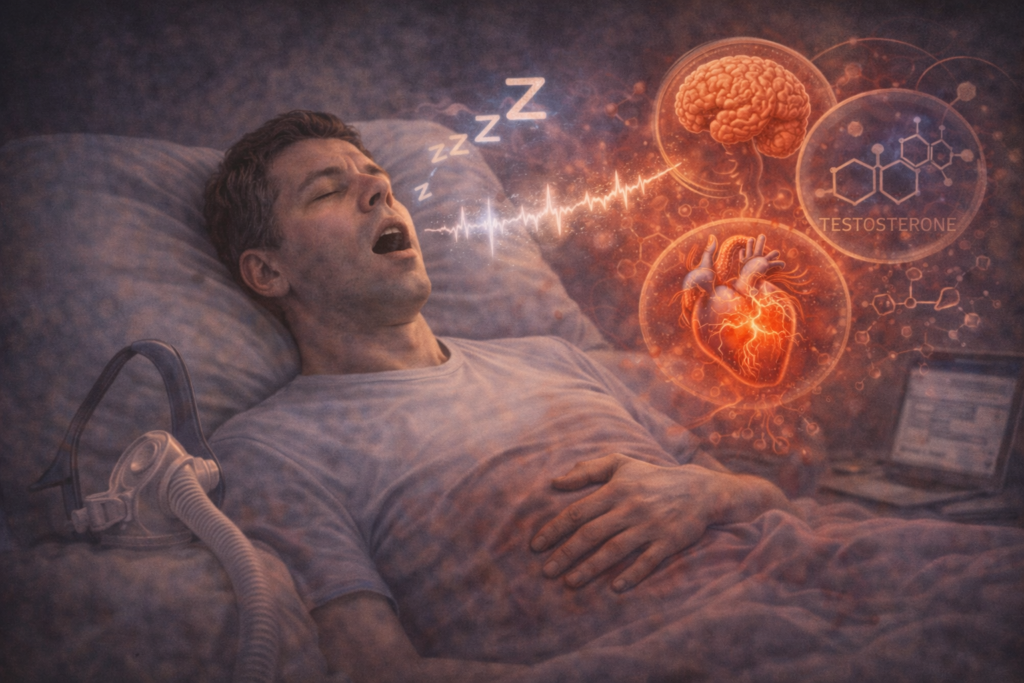
“If your sleep is broken, your whole life gets blurry.”
– Wellness Kraft
Introduction
Let’s start with the most common lie men accidentally tell themselves:
“I sleep eight hours.”
What they really mean is: “I was in bed for eight hours.”
Because with sleep apnea, you can spend the whole night “sleeping” and still wake up feeling like your brain got dragged behind a car. You’re tired, but not the usual tired. It’s the tired that makes you forget why you walked into a room. The kind that turns you impatient. The kind that makes you want silence, space, and no one asking questions.
And here’s the part that makes it sneaky: sleep apnea doesn’t always look dramatic. It can look like a guy who:
- snores “like a chainsaw” (everyone jokes about it)
- falls asleep on the couch in minutes
- wakes up with a dry mouth and headache
- gets irritated easily, especially in the morning
- can’t focus like he used to
- feels his drive and confidence slipping
- gains belly fat even when he’s “not eating that much.”
- keeps getting told his blood pressure is high
- has low energy and low motivation, but can’t explain why
If you’re reading this and thinking, “That’s… uncomfortably familiar,” don’t panic. But also don’t ignore it. Sleep apnea is one of the most fixable “slow damage” problems out there, once you see it clearly.
Quick check-in (answer honestly):
Do you ever wake up feeling like you’re already behind, before the day even starts?
That’s a classic sign that your sleep might not be doing its job.
What Sleep Apnea Actually Is
The most common type is obstructive sleep apnea (OSA). In OSA, the airway partially or fully collapses during sleep. Your breathing becomes shallow or pauses. Your oxygen can drop. Your brain senses danger and jolts you awake just enough to reopen the airway.
You usually don’t remember these micro-wakeups. But your body does.
So the night becomes a cycle:
airway collapse → oxygen dips → stress response → brief arousal → airway opens → repeat
Sometimes this happens dozens of times per hour.
That means even if you’re “asleep,” your brain is running emergency protocols instead of recovery programs.
Why Men Miss It (Or Minimize It)
Because the symptoms can look like normal life:
- “I’m tired because work is stressful.”
- “I’m moody because I’m busy.”
- “I gained weight because I’m older now.”
- “I have brain fog because I’m on screens all day.”
- “My libido is down because I’m tired.”
And yes, those things can be true. But sleep apnea can be the hidden engine behind all of them, like a leak in the foundation that makes every room tilt.
Also, men are more likely to treat snoring as a joke instead of a clue. Everyone laughs… until they stop laughing because the consequences show up in labs, blood pressure readings, and relationships.
A Story That Happens Every Day
Jason is 41. He’s not “unhealthy,” at least not in the way people imagine unhealthy. He works, pays bills, and tries to hit the gym when he can. His weight has crept up around the waist over the last few years, but he calls it “dad weight” even though he doesn’t have kids.
His wife complains about snoring, but it’s become a running gag in their home. She nudges him at night. He rolls over. Sometimes she leaves the room.
Jason’s bigger problem is his daytime life.
He wakes up feeling heavy. He hits snooze twice. He needs caffeine to feel human. He’s forgetting small things at work. He’s less patient. He feels like his fuse is shorter. By afternoon, he gets a second wind that feels weirdly wired, and then at night, he crashes but still doesn’t wake up refreshed.
He also notices something he doesn’t love admitting: his libido has dipped, and his motivation feels flatter. He starts wondering about testosterone, aging, depression, and stress. He tries supplements. He tries “pushing harder.”
Then one day, he nearly drifts off at a red light. It scares him enough to book an appointment.
That’s how many men finally take it seriously, not because snoring is annoying, but because life starts getting risky.
And the twist is: once sleep apnea is treated, many men describe it as getting their brain back. Not perfection, but clarity. Like someone cleaned the fog off the windshield.
How Sleep Apnea Hits Men Hard (Heart, Hormones, Focus)
1) Heart and blood pressure
When your oxygen drops repeatedly at night, your body responds as if it’s under attack. Blood pressure can rise. The cardiovascular system gets stressed. Over time, untreated sleep apnea is associated with higher rates of hypertension and other cardiovascular problems.
A simple way to imagine it: your heart is trying to recover at night, but sleep apnea keeps pulling the fire alarm.
2) Hormones and testosterone vibes
Even when labs aren’t dramatically “low,” men with sleep apnea often describe symptoms that feel hormonal:
- low drive
- decreased libido
- erectile issues
- reduced energy
- mood changes
Why? Because good sleep is one of the key builders of healthy hormone patterns. Fragmented sleep can disrupt the rhythm your body uses for hormonal regulation. And if you’re also gaining weight and carrying more visceral fat, that can add another layer of hormonal disruption.
3) Focus, mood, and that “short fuse” feeling
Sleep apnea doesn’t just make you tired. It can make you:
- forgetful
- slower to process
- less emotionally resilient
- more irritable
- more anxious or “on edge.”
- more likely to feel low or unmotivated
Not because you’re weak. Because your brain is running on a choppy battery.
4) Weight gain and belly fat feedback loop
Sleep apnea and weight can create a loop:
- weight gain can worsen airway collapse
- worse sleep can increase hunger signals and cravings
- fatigue reduces activity
- stress hormones rise
So the belly grows, the apnea worsens, and the day feels harder. The trap isn’t about willpower. It’s about physiology.
Symptoms Men Should Not Shrug Off
You don’t need all of these for sleep apnea to be real. But the more you recognize, the more it’s worth investigating.
Night signs:
- loud snoring
- choking, gasping, or snorting sounds during sleep
- breathing pauses (often noticed by a partner)
- frequent waking
- night sweats
- waking to pee often
- dry mouth in the morning
Day signs:
- morning headaches
- unrefreshing sleep even after “enough hours.”
- daytime sleepiness (especially while driving, meetings, or watching TV)
- brain fog, poor focus
- irritability, mood swings
- lower libido or erectile issues
- high blood pressure that’s hard to control
“Is It Just Snoring or Real Sleep Apnea?”
Here’s the practical truth: snoring alone doesn’t equal sleep apnea, and sleep apnea doesn’t always equal loud snoring.
But if snoring is accompanied by daytime fatigue, witnessed pauses in breathing, gasping, or high blood pressure, it’s worth screening.
A useful rule:
If your snoring is accompanied by symptoms that affect your daytime functioning, treat it as a health clue, not a personality trait.
Diagnosis: What It Usually Looks Like
Most men imagine a complicated hospital setup. In reality, many people start with:
- a clinical screening conversation
- questionnaires about sleepiness and risk factors
- a sleep study (sometimes at home, sometimes in a lab)
This is not about labeling you. It’s about getting data.
Because once you have data, treatment becomes targeted and effective.
Treatment: What Actually Works (And What Men Usually Hate Until They Try It)
CPAP and PAP therapy
Yes, it’s the mask. Yes, people resist it. And yes, it’s often the most effective treatment for many men.
The irony is how many men go from “No way I’m wearing that” to “Why didn’t I do this two years ago?”
Why it helps: it keeps the airway open, preventing the collapse and the oxygen dips.
If the mask feels uncomfortable, it’s usually not “CPAP doesn’t work.” It’s “the setup needs tuning.” Different masks, settings, humidification, and fit changes can turn it from awful to workable.
Oral appliances
For some men, a dental device that repositions the jaw can reduce apnea severity, especially in specific anatomical patterns.
Lifestyle changes that genuinely matter
This isn’t “just lose weight.” It’s: reduce the factors that worsen airway collapse.
Practical examples:
- avoid alcohol near bedtime (it relaxes airway muscles)
- side sleeping can reduce obstruction for some men
- address nasal congestion
- consistent sleep schedule
- weight management, if applicable (even modest loss can help some people)
Surgery and other interventions
In some instances, surgical options or other device-based treatments may be considered, depending on anatomy and severity.
The Relationship Angle (Because This Is Not Only About You)
Sleep apnea often affects partners, too:
- they lose sleep from snoring
- they worry about breathing pauses
- they develop resentment
- intimacy suffers because everyone is tired and irritable
One of the most underrated benefits of treating sleep apnea is that it improves household mood. When sleep improves, patience returns. Presence returns. Even the simple act of waking up without dread can change how a relationship feels.
What To Do Next
If this post hit a nerve, here’s your next-step plan:
- Ask someone who sleeps near you: Do I snore loudly? Do I stop breathing? Do I gasp?
- Notice your daytime function: Are you sleepy while driving? In meetings? Watching TV?
- Check your blood pressure if you haven’t recently.
- Talk to a clinician about sleep apnea screening. Mention symptoms and any witnessed pauses.
- If you get treatment, treat it like a tool, not a judgment. You’re not “weak.” You’re upgrading your system.
Key Takeaways
- Sleep apnea isn’t just snoring. It’s disrupted breathing that fragments sleep and stresses your body nightly.
- In men, it can show up as high blood pressure, brain fog, irritability, low energy, reduced libido, and weight gain.
- Getting tested is usually straightforward, and treatment can be life-changing.
- CPAP is often highly effective, and comfort issues are usually solvable with the right setup.
- If you’re sleepy while driving or have witnessed breathing pauses, don’t delay.
FAQs
1) I snore, but I don’t feel sleepy. Should I still worry?
Maybe, depending on the whole picture. Some men don’t register “sleepiness” as sleepiness; they register it as being cranky, unmotivated, foggy, or needing caffeine constantly. Also, your body can adapt to being under-rested in a way that makes exhaustion feel normal. If snoring is loud and consistent, and especially if there are pauses in breathing or gasping, it’s worth screening even if you don’t feel dramatically sleepy.
2) Can sleep apnea really affect testosterone and sex drive?
Sleep is one of the pillars of hormone regulation. Fragmented sleep can disrupt standard hormonal patterns, and many men with sleep apnea report lower libido, erectile issues, and reduced drive. It’s not always “your testosterone is low,” it can be “your recovery system is broken.” Treating sleep apnea won’t magically fix everything for everyone, but it can remove a significant barrier to healthy energy and hormonal balance.
3) Is CPAP the only real solution?
No, but it’s often the most effective for moderate to severe obstructive sleep apnea. Other options include oral appliances, positional therapy, lifestyle changes, and, in selected cases, other interventions based on anatomy. The right plan depends on severity, anatomy, and personal comfort. The most important thing is not choosing the “perfect” treatment, it’s selecting a treatment you’ll actually use.
4) Why do I wake up to pee so often at night?
Frequent nighttime urination can be related to sleep fragmentation and oxygen dips. When sleep is disrupted, your body’s signals and hormones can shift in ways that increase nighttime bathroom trips. Many men are shocked when this improves after sleep apnea is treated, because they assumed it was only “aging” or “prostate.”
5) What’s the most enormous red flag that means I should act now?
Daytime sleepiness while driving is a big one. If you’ve ever felt yourself nodding off at the wheel, that’s urgent. Also, if a partner has witnessed breathing pauses or choking/gasping in sleep, don’t treat it casually. It’s not about fear, it’s about safety and prevention.
Research Insight
Medical references explain that obstructive sleep apnea involves repeated interruptions in breathing during sleep, often accompanied by loud snoring or choking. That treatment (especially positive airway pressure therapies like CPAP) helps keep the airway open and can improve daytime sleepiness and quality of life. NCBI+3MedlinePlus+3MedlinePlus+3
Major clinical and cardiovascular sources describe strong associations between obstructive sleep apnea and cardiovascular risks such as high blood pressure, coronary artery disease, stroke, heart failure, and arrhythmias, emphasizing the importance of recognition and treatment. AHA Journals+3Mayo Clinic+3AHA Journals+3
Research literature also discusses links between obstructive sleep apnea and men’s health concerns, such as low testosterone and erectile dysfunction, with obesity and sleep fragmentation as important interacting factors. PMC+2auanews.net+2
Links (paste as raw URLs in WordPress for auto-clickable sources):
https://medlineplus.gov/sleepapnea.html
https://medlineplus.gov/ency/article/000811.htm
https://www.mayoclinic.org/diseases-conditions/obstructive-sleep-apnea/symptoms-causes/syc-20352090
https://www.heart.org/en/health-topics/sleep-disorders/sleep-apnea-and-heart-disease-stroke
https://www.ahajournals.org/doi/10.1161/CIR.0000000000000988
https://pmc.ncbi.nlm.nih.gov/articles/PMC8350060/
Concluding Thoughts
Sleep apnea is one of those problems that quietly taxes every part of life: your heart, your hormones, your mood, your focus, your relationships, your confidence.
And the most frustrating part is that many men live with it for years because the symptoms feel “normal enough” to tolerate.
But you don’t have to tolerate it.
Better sleep isn’t a luxury. It’s a health intervention. If your nights are full of breathing battles, your days will keep paying the price.




Join the conversation