
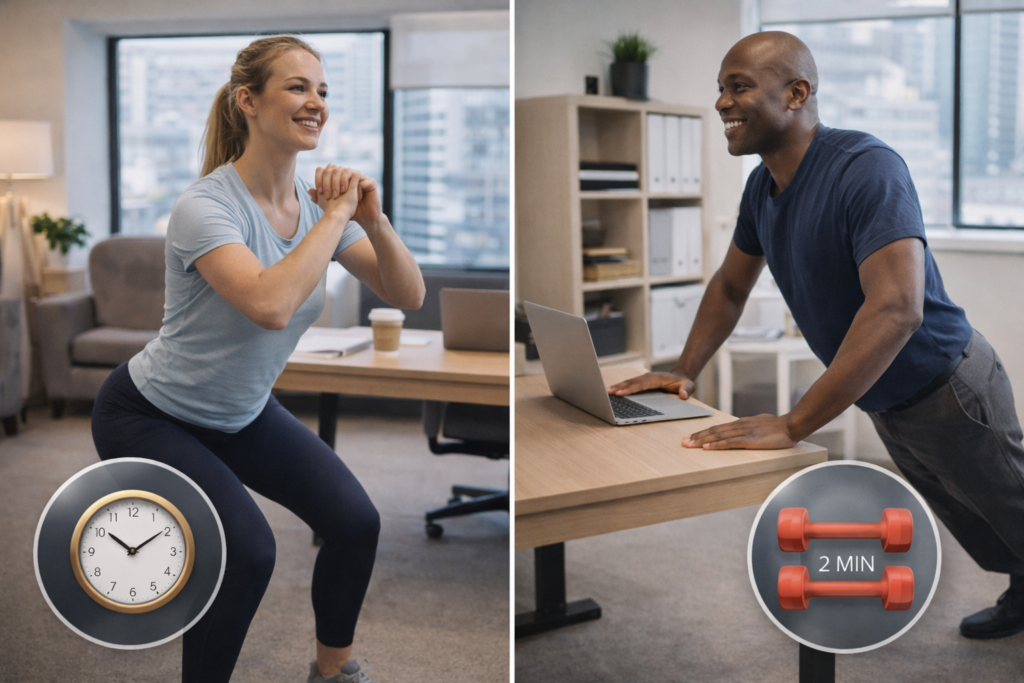
“Small moves, repeated often, become big change.” – Wellness Kraft
Introduction
Most people do not “lack motivation.” They lack space.
You wake up with good intentions, then the day starts sprinting. Meetings. Work. Family. Errands. Your brain is busy, and your body becomes furniture. By evening, you are tired, and the idea of a complete workout feels like trying to climb stairs with a suitcase.
Micro-workouts fix that problem by lowering the entry fee.
They do not ask you for an hour. They ask you for one moment, then another moment, then another. The goal is not to become a gym person overnight. The goal is to stop living in long, uninterrupted blocks of sitting and to give your body regular reminders that it is meant to move.
If you have ever thought, “I cannot be fit because I do not have time,” this approach was basically made for you.
What Micro-Workouts Really Are
A micro-workout (also called an “exercise snack”) is a short bout of movement you do during your normal day. It can be planned, such as a 3-minute routine after lunch, or unplanned, such as sprinting up the stairs instead of taking the elevator.
The point is not to do one heroic burst and call it fitness. The goal is to increase activity, reduce prolonged sitting, and retrain your body to view activity as regular again.
Think of it like brushing your teeth. You do not do it once a week for two hours. You do it regularly in small chunks, and that consistency delivers results.
Why This Works (Without the Over-Science)
Your body responds strongly to repeated signals.
When you sit for long periods, your metabolism slows, blood sugar handling becomes less efficient, and your body becomes “stiff” in both muscles and circulation. You do not need to become an athlete to improve this. You need to interrupt the pattern.
Micro-workouts work because they do two powerful things:
They break up long sitting times.
They create frequent spikes of movement that build fitness over time.
Even a short burst can wake up your muscles, improve circulation, and reset your energy. And when you repeat those bursts daily, your body adapts. Your stamina improves. Your legs feel stronger. Stairs stop feeling like a punishment.
This is not motivational talk. It is how adaptation works. The body does not need a perfect workout. It requires a repeatable stimulus.
The Real-Life Trap Micro-Workouts Solve
A typical pattern looks like this:
You plan a “perfect” gym schedule.
You miss one day.
You miss another day.
Now you feel guilty.
Guilt turns into avoidance.
Avoidance turns into “I’ll start next week.”
Micro-workouts don’t allow that spiral to grow. Because even on a messy day, you can still do something. And “something” sustains the identity: “I am a person who moves.”
That identity is what eventually makes bigger workouts possible again.
A Story You Might Recognize
Emily works a desk job and has a long commute. She kept telling herself she would start working out “properly,” but weeks kept disappearing. Her step count was low, her back felt tight, and she felt tired in a way that sleep did not fix.
Instead of going to the gym, she set one rule: every time she made tea or waited for food to heat, she would walk for two minutes.
Not a complete workout. Just movement.
She did wall push-ups. She did squats, holding the kitchen counter. She did stair climbs. She did quick marching in place. She started taking calls, standing, and pacing.
At first, it felt silly. Then it felt normal. After a few weeks, she noticed something surprising: her energy improved, her legs felt stronger, and she stopped getting that heavy afternoon slump as often.
The most significant change was not weight. It was momentum. She finally had a system that fit her life.
That is the real promise of micro-workouts. They are not magic. They are doable. And “doable” beats “perfect” every time.
How to Do Micro-Workouts Correctly
Micro-workouts fail when people treat them like random chaos. They work when you use a simple structure.
1) Pick a tiny goal you can win daily
Choose something so small you can do it even on your worst day.
Examples:
Two minutes of movement, three times per day.
One minute of stairs, twice per day.
A five-minute routine after lunch.
Once that becomes normal, you increase.
2) Attach it to a daily trigger
The easiest way to build a habit is to connect it to something that already happens.
Examples:
After brushing teeth.
After lunch.
Before your first coffee.
Every time you use the washroom, do one set.
Before your evening shower.
3) Use movements that feel safe and repeatable
Micro-workouts are not the place for risky ego lifts. Choose moves you can do with good form.
4) Do not chase soreness
Soreness is not a requirement. The goal is consistency and progressive effort, not suffering.
5) Let it build into a bigger routine naturally
Micro-workouts often become a gateway. After a few weeks, many people start adding longer walks, then short strength sessions, then full workouts. Not because someone forced them, but because their body begins to feel ready.
Micro-Workout Menus You Can Rotate
Choose one “menu” and repeat it for a week. You will progress faster by repeating than by constantly changing.
Menu A: Strength Snack (3 minutes)
Do slow, controlled reps. Rest only as needed.
Squats
Wall push-ups (or incline push-ups)
Glute bridge (on the floor or bed edge)
Menu B: Cardio Snack (2 minutes)
Stair climbing (up and down safely)
Fast marching in place
Brisk walk around your room or corridor
Menu C: Desk Reset (2 minutes)
Sit-to-stand from chair
Calf raises
Shoulder blade squeezes and gentle neck mobility
Menu D: “I Have Zero Time” Snack (60 seconds)
10–15 squats
10 wall push-ups
30 seconds fast marching
That is it. One minute. Done. No drama.
The Biggest Mistakes to Avoid
Do not do micro-workouts only once a day and expect huge change. Frequency is the advantage here.
Do not turn every micro-session into a max-effort punishment. You will quit.
Do not ignore pain. Challenge is fine. Sharp pain is a stop sign.
Do not wait for motivation. This method is built for days when motivation is missing.
Key Takeaways
- Micro-workouts are short bursts of movement repeated throughout the day.
- They work best when you do them frequently, not perfectly.
- They are handy for people who sit for long hours and struggle to find workout time.
- Attach them to daily triggers to make them automatic.
- Keep movements simple, safe, and repeatable, then increase gradually.
Research Insight
Scientific reviews describe “exercise snacks” as very short bouts of physical activity repeated throughout the day, proposed as a time-efficient strategy to improve cardiorespiratory fitness and support cardiometabolic health, especially for people who are mostly sedentary.
Research on breaking up prolonged sitting shows that interrupting long sitting time with short activity breaks can improve post-meal blood sugar and insulin responses, which is one reason micro-workouts are viewed as more than “just a few random moves.”
Public health guidance also emphasizes that weekly activity targets can be accumulated in smaller chunks, meaning short bouts can still contribute meaningfully to your total physical activity.
Links:
https://pubmed.ncbi.nlm.nih.gov/34669625/
https://pmc.ncbi.nlm.nih.gov/articles/PMC3329818/
https://www.cdc.gov/physical-activity-basics/guidelines/adults.html
https://bmjgroup.com/exercise-snacks-may-boost-cardiorespiratory-fitness-of-physically-inactive-adults/
FAQs
1) Are micro-workouts enough to get fit?
They may be enough to drive meaningful improvement if you are currently inactive, because consistency alone fosters adaptation. For advanced goals such as significant muscle gain or endurance performance, you may eventually need longer sessions. For health, energy, and momentum, micro-workouts can provide a strong foundation.
2) How many micro-workouts should I do per day?
A simple starting target is two to four short bouts per day. The best number is the one you can repeat without feeling overwhelmed. If you do three minutes after breakfast, lunch, and dinner, that is already nine minutes a day, and it adds up fast.
3) Should micro-workouts be intense?
They can be moderate or vigorous, but they do not have to be extreme. If intensity makes you quit, it is the wrong intensity. Start easy, then gradually push effort once the habit is stable.
4) Will micro-workouts help with belly fat?
They can help by increasing daily movement, improving metabolic health, and supporting consistency. Fat loss still depends heavily on nutrition and overall activity balance, but micro-workouts reduce the “all-day sitting” problem that often keeps belly fat stubborn.
5) What is the easiest micro-workout for beginners?
A safe beginner combo is chair sit-to-stands, wall push-ups, and a one-minute brisk walk or march in place. It trains legs, the upper body, and circulation without complex technique.
Concluding Thoughts
Micro-workouts succeed because they respect reality. They fit into your day instead of demanding that your day be rebuilt around them.
If you want the simplest starting plan, do this:
Move for two minutes after lunch every day for one week. That is it—no extra rules.
Once you prove to yourself that movement can be easy to start, everything else becomes possible.




Join the conversation