
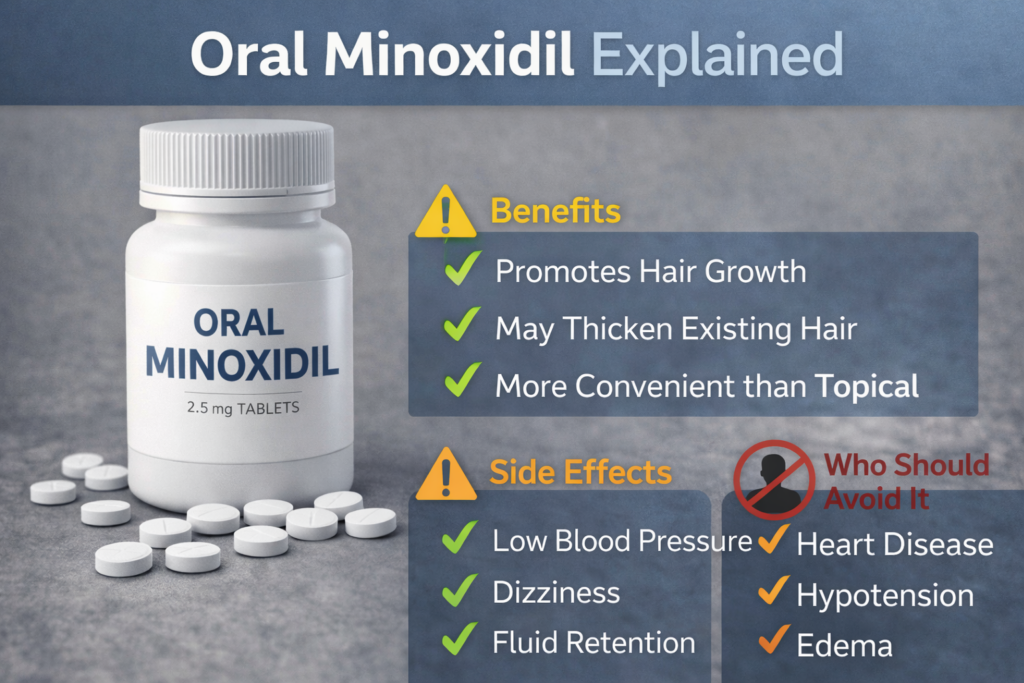
“Convenient doesn’t mean harmless. It means you need clarity.” – Wellness Kraft
Introduction
If you have ever tried topical minoxidil and thought, “I can’t live like this,” you’re not alone.
Some people hate the greasy feel. Some get scalp irritation or itching. Some forget it constantly because twice-a-day application doesn’t match real life. And some simply want something easier. That’s usually how oral minoxidil enters the conversation: convenience.
But convenience can be a trap if you don’t understand the trade-off.
Topical minoxidil is applied to the scalp and is commonly used for pattern hair loss. Oral minoxidil is a tablet. It travels through your bloodstream and can influence hair follicles anywhere, not only the scalp. That “whole-body” effect is one reason it can be helpful for hair growth, but it’s also why unwanted side effects can happen.
So let’s talk about it like adults. No fear-mongering. No hype. Just what’s actually happening.
What Oral Minoxidil Is
Minoxidil was originally developed as an oral medication for high blood pressure. Later, people noticed an obvious side effect: increased hair growth. That observation helped push minoxidil into the hair-loss world, especially in topical form.
Oral minoxidil for hair loss is typically prescribed in much lower doses than the doses used for blood pressure. It is commonly considered an off-label use for hair loss, meaning it is prescribed for a purpose that is not the original “official” labeling.
The important point: because it is taken orally, the effects are systemic. That means you have to treat it with the respect you’d give any medicine that can influence blood pressure and heart-related symptoms.
Why People Consider Oral Minoxidil Instead of Topical
Most people consider oral minoxidil for one of these reasons:
They cannot tolerate topical minoxidil because of irritation, dandruff-like flaking, or itching.
They find topical application hard to maintain consistently.
They want a simpler routine and better adherence.
They want scalp hair growth and also have thinning in other areas like eyebrows (only in certain cases and under medical guidance).
They already tried topical and didn’t see results, and their clinician is discussing alternative strategies.
It’s worth saying clearly: oral minoxidil is not automatically “better.” It is “different.” It fits certain people better and fits others worse.
What Benefits People Actually Notice
When oral minoxidil works well, people often describe the benefits in a few phases.
Phase 1: Less “hopelessness,” more stability
Many users notice that shedding feels less intense after some time, or at least feels more stable. This is not always immediate, and early shedding can happen in some people, which I’ll explain later. But emotionally, a lot of people feel relief when the situation stops feeling like a runaway train.
Phase 2: Early regrowth signs
This can show up as small new hairs along the hairline or part line, or a “fuzz” stage in areas that felt empty. The hair can look uneven at first because hair cycles don’t restart in perfect sync.
Phase 3: Thickness and density improvements
With time and consistency, some people notice better density, thicker strands, and less scalp show-through in photos. This phase is slow. Hair improvements rarely feel dramatic week to week. The change often becomes obvious only when you compare photos several months apart.
A realistic mindset helps here: hair growth is slow biology, not instant cosmetics.
The Side Effects People Need to Know (Without Panic)
Here’s the honest part. Oral minoxidil can be well-tolerated for many people, but it has known side effects. The most common ones are not “rare horror stories.” They are predictable and usually dose-related.
1) Unwanted hair growth in unwanted places
Because oral minoxidil works throughout the body, it can stimulate hair growth beyond the scalp. This may show up as facial hair, increased body hair, or hair in areas you didn’t ask for.
For some people, this is mild and manageable. For others, it becomes the reason they stop.
This is especially important for women, because even small changes in facial hair can feel emotionally heavy and socially stressful.
2) Swelling or fluid retention
Some people notice puffiness in the face or swelling in the ankles. This is not something to ignore, especially if it is increasing or uncomfortable. It can sometimes improve with dose adjustment or discontinuation, but it needs clinician guidance.
3) Lightheadedness or dizziness
Since minoxidil can affect blood pressure, some people feel lightheaded, especially early on or if they already tend toward low blood pressure.
If you’re the kind of person who stands up quickly and already gets dizzy, this matters.
4) Faster heartbeat or palpitations
Some people notice a racing heartbeat or palpitations. This is a “stop and talk to your prescriber” symptom, not something you push through.
5) Headache and sleep disturbance (in some people)
Some people report headaches or difficulty sleeping. Sometimes it’s dose timing. Sometimes it’s sensitivity. Sometimes it’s not related, but it should still be evaluated if it starts after the medication.
6) Temporary shedding at the start
This surprises people and triggers panic.
Minoxidil can shift hair follicles into a new cycle. That can cause some older hairs to shed so new growth can begin. If someone starts oral minoxidil and sees shedding increase early, they often assume it’s “making things worse” and quit before the beneficial phase begins.
Not everyone experiences this. But it can happen. The key is to be prepared mentally and to track with time, not emotion.
Who Should Avoid Oral Minoxidil or Be Extra Cautious
This is where people need to stop self-prescribing and guessing.
Oral minoxidil can be a poor fit or require strong caution for people with:
A history of heart rhythm issues, significant heart disease, or concerning palpitations.
Low blood pressure problems or frequent dizziness.
A history of fluid retention issues.
Kidney disease or complex systemic medical conditions (needs clinician oversight).
Pregnancy or breastfeeding (discuss with a clinician; most responsible prescribing avoids this unless a specialist explicitly guides otherwise).
Medication interactions that may increase cardiovascular side effects (your clinician and pharmacist should check this).
Also, if you have uncontrolled hypertension or are on multiple blood pressure medications, this becomes a “medical decision,” not a “hair routine.”
A Story That Shows the Real Trade-Off
Megan is 29 and has thinning at the part line that has been slowly creeping over the last year. She tried topical minoxidil. It worked a little, but it also irritated her scalp so much that she couldn’t stay consistent. Some weeks she used it. Other weeks she avoided it because it made her scalp feel inflamed. And inconsistent treatment often creates inconsistent results, which creates more anxiety.
She finally sees a dermatologist. They discuss options. Oral minoxidil comes up because Megan’s biggest problem is not “no treatment.” Her biggest problem is “I can’t stick to the one I have.”
Megan starts low-dose oral minoxidil under supervision. At first she loves the simplicity. Then she notices something she didn’t expect: extra hair growth on her face. Not extreme, but enough that she starts checking the mirror too often. That becomes her new anxiety.
She goes back to her clinician. They adjust her plan. Lower dose, monitor symptoms, and discuss hair removal strategies if needed. Over time, Megan finds a balance where she gets scalp improvement without feeling like the side effects are stealing her confidence.
That’s the real oral minoxidil story for many people: it’s not “perfect” or “terrible.” It’s a trade-off you manage.
What a Safe, Smart Starting Conversation Looks Like
If you’re discussing oral minoxidil with a clinician, you want clarity on these points:
Why are we choosing oral instead of topical in my case?
What dose are we starting with and why?
What side effects should make me stop immediately and contact you?
Do I need baseline blood pressure readings or periodic monitoring?
What is the realistic timeline to judge effectiveness?
What should I do if I notice unwanted hair growth?
This turns the medicine into a plan, not a gamble.
How Long It Takes to See Results (Realistic Expectations)
Hair cycles are slow. Most people should think in months, not weeks.
Early changes can appear gradually, but meaningful assessment often needs consistent use over a longer window. Many people evaluate too early, quit, and then feel like “nothing works.”
A practical way to protect your sanity is to take one photo every two weeks in the same lighting and angle. Not daily. Daily tracking fuels anxiety and creates false conclusions.
Oral Minoxidil vs Topical Minoxidil
This is the simplest comparison that actually matters:
Topical minoxidil
Good when you can tolerate it and apply consistently.
More localized effect.
Scalp irritation can be a dealbreaker for some people.
Oral minoxidil
More convenient for many people.
Systemic effect, so side effects can include unwanted hair growth and cardiovascular-related symptoms.
Requires careful prescribing and monitoring in certain people.
Neither is “the winner.” Your body, lifestyle, and risk profile decide.
What People Often Miss: Hair Loss Diagnosis Still Matters
Oral minoxidil is not a universal hair-loss pill.
If your hair loss is due to a thyroid issue, iron deficiency, severe stress shedding (telogen effluvium), traction alopecia, or inflammatory scalp conditions, you still need to address the root cause.
Minoxidil can support growth, but it doesn’t magically correct everything underneath. Getting the diagnosis right is still the most cost-effective step.
Key Takeaways
- Oral minoxidil can be a useful option for some people who can’t tolerate or stick to topical minoxidil.
- Because it works through the whole body, it can cause side effects like unwanted hair growth, swelling, dizziness, palpitations, and headaches in some people.
- It should be prescribed thoughtfully, especially for anyone with heart issues, blood pressure concerns, kidney disease, pregnancy/breastfeeding, or interacting medications.
- Early shedding can happen for some people and can be part of cycle shifting rather than “failure.”
- The best outcomes come from a real plan: correct diagnosis, consistent use, and monitoring for side effects.
Research Insight
Clinical studies and large real-world reviews describe low-dose oral minoxidil as an off-label option used by clinicians for different hair loss patterns, with commonly reported side effects including hypertrichosis (unwanted hair growth) and a smaller set of systemic effects such as lightheadedness, fluid retention/edema, tachycardia, and headache. (These are generally discussed as dose-dependent and patient-dependent.) PubMed+2Cleveland Clinic+2
An international expert consensus statement has also been published to guide clinicians on off-label low-dose oral minoxidil use in hair loss patients, including practical considerations and cautions. PubMed+1
Trusted references on oral minoxidil as a medicine for blood pressure also list systemic side effects such as fast heartbeat, weight gain/fluid retention, and other cardiovascular symptoms, supporting why medical supervision matters. Mayo Clinic
Links:
https://pubmed.ncbi.nlm.nih.gov/33639244/
https://consultqd.clevelandclinic.org/oral-minoxidil-offers-strong-results-against-alopecia
https://jamanetwork.com/journals/jamadermatology/fullarticle/2817326
https://pubmed.ncbi.nlm.nih.gov/39565602/
https://www.mayoclinic.org/drugs-supplements/minoxidil-oral-route/description/drg-20068757
FAQs
1) Is oral minoxidil “stronger” than topical minoxidil?
Not automatically. Oral minoxidil may be more convenient, which can improve consistency, and consistency often improves outcomes. But “stronger” isn’t the right word because tolerance and side effects matter. Some people do better with topical because it stays more localized. Others do better with oral because they can actually stick to it.
2) Why am I shedding more after starting oral minoxidil?
Some people experience temporary increased shedding early because hair follicles shift cycles. It can feel alarming, but it doesn’t always mean the treatment is failing. The bigger question is what happens over the following months. If shedding is extreme, prolonged, or paired with concerning symptoms, contact your prescriber.
3) What is the most common side effect people complain about?
Unwanted hair growth in areas like the face or body is a frequent complaint because oral minoxidil can stimulate follicles beyond the scalp. For some people it’s mild, for others it’s a dealbreaker. This is exactly why dose and expectations should be discussed early.
4) Who should not take oral minoxidil?
People with certain heart conditions, problematic low blood pressure, significant fluid retention history, kidney disease, pregnancy or breastfeeding, or complex medication interactions should not start it casually. This decision should be made with a clinician who considers your medical history and monitors appropriately.
5) If I stop oral minoxidil, will I lose the hair I gained?
Minoxidil generally supports ongoing growth while you use it. If you stop, the benefit often fades gradually over time and you may return toward your baseline hair pattern. That doesn’t mean you “ruined” your hair. It means the support signal is removed. If you’re considering stopping, talk to your clinician about transition plans.
Concluding Thoughts
Oral minoxidil is popular for a very human reason: it makes hair treatment easier to maintain. And consistency is half the battle in hair recovery.
But because it’s systemic, it’s not something to copy from a random routine online. It should be a decision that matches your health profile and your risk tolerance. If you approach it with clarity, monitoring, and realistic timelines, it can be a smart tool. If you approach it like a harmless vitamin, it can become stressful fast.
The goal isn’t to chase a miracle. The goal is to choose a plan you can live with and stick to safely.




Join the conversation