
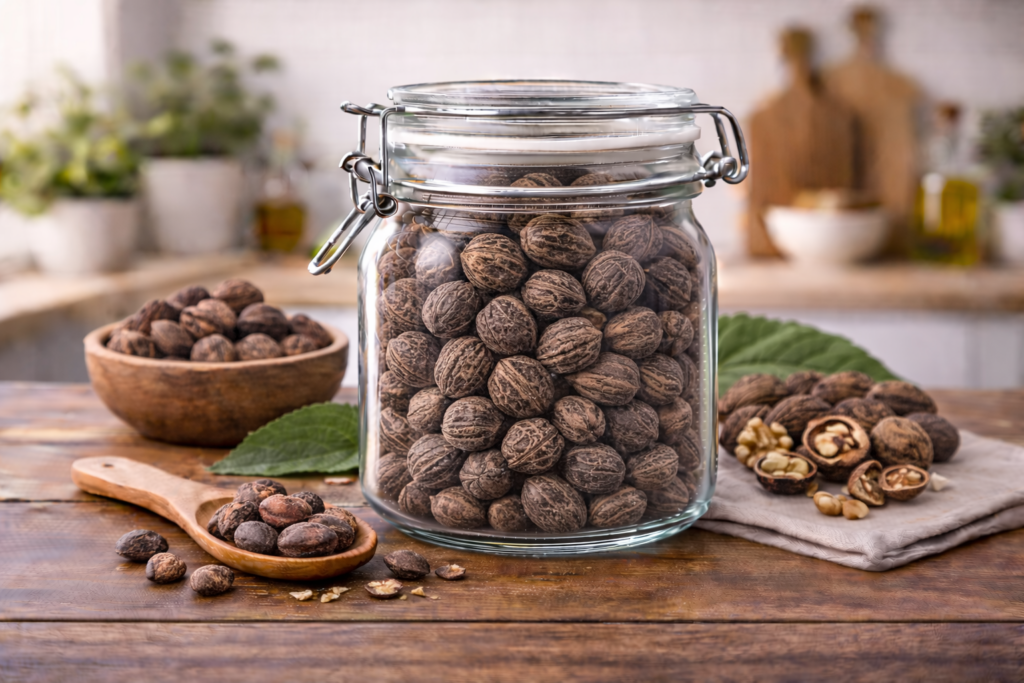
Black walnut has a bold, earthy flavour that feels deeper than regular walnuts. It works best in small amounts because it can overpower milder foods.
In a nutshell: The values provided are approximate and can vary depending on the size and ripeness.
1) Black walnut
Nutritional facts per 100g
| Nutrient | Amount Per 100g | % Daily Value* |
|---|---|---|
| Calories | 619 kcal | 31% |
| Carbohydrates | 9.6 g | 3% |
| Fiber | 6.8 g | 27% |
| Sugars | 2.6 g | – |
| Protein | 24.1 g | 48% |
| Fat | 59.3 g | 76% |
| Vitamin A | 20 IU | 0% |
| Vitamin C | 1.7 mg | 3% |
| Potassium | 523 mg | 11% |
| Calcium | 61 mg | 6% |
Pros
- Very satisfying because it is high in healthy fats and protein.
- Fiber helps make small portions feel filling.
- Great “crunch add-on” to upgrade oats, curd, salads, and baked foods.
Cons
- Very calorie-dense, portions can get heavy fast.
- Nut allergies are possible, avoid if you are sensitive to tree nuts.
- Strong taste can overpower light dishes if you add too much.
Right time to eat
- Mid-morning snack with fruit or curd.
- Evening snack to reduce junk cravings.
Health benefits
- Supports satiety, helpful for portion control.
- Good fat + protein combination for steadier energy.
- Fiber supports digestion when eaten in moderation.
Best way to eat
- Use chopped as a topping, not as a large bowl snack.
- Pair with fruit or curd for a balanced bite.
- Store airtight to keep flavour fresh.
*Percent Daily Values are based on a 2,000 calorie diet.


Join the conversation