
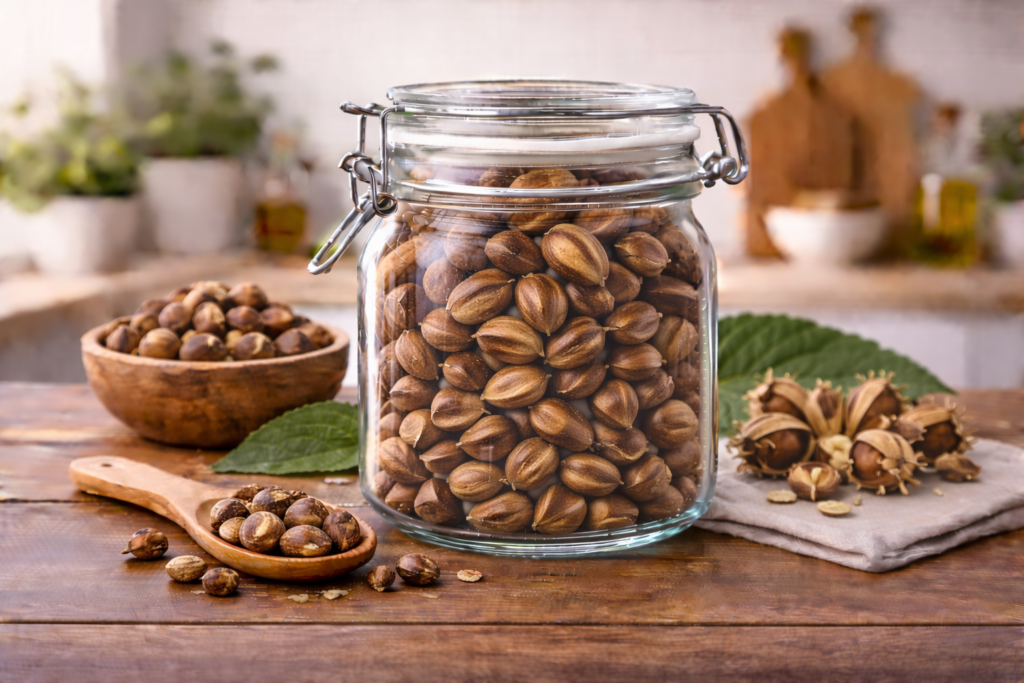
Beech nuts are small and earthy, and they taste best when roasted. Think of them as a “wild-style” nut: rich, dense, and meant for small servings.
In a nutshell: The values provided are approximate and can vary depending on the species, roasting level, and source.
1) Beech nut
Nutritional facts per 100g
| Nutrient | Amount Per 100g | % Daily Value* |
|---|---|---|
| Calories | 576 kcal | 29% |
| Carbohydrates | 33.5 g | 12% |
| Fiber | 6.5 g | 23% |
| Sugars | 4.5 g | – |
| Protein | 6.2 g | 12% |
| Fat | 49.7 g | 64% |
| Vitamin A | 0 IU | 0% |
| Vitamin C | 0 mg | 0% |
| Potassium | 817 mg | 17% |
| Calcium | 35 mg | 3% |
Pros
- Energy-dense, so small portions can feel satisfying.
- Good for variety if you explore wild or specialty nuts.
- Works well roasted as a crunchy snack.
Cons
- Calorie-dense, overeating is easy.
- Raw beech nuts are not a good idea; roasting is preferred.
- Not suitable for people with nut allergy.
Right time to eat
- Mid-morning or evening snack in small amounts.
- With meals as a topping to add crunch.
Health benefits
- Supports better fullness when used as a measured snack.
- Fiber supports digestion routines.
- Helps add variety to your nut rotation.
Best way to eat
- Eat roasted, not raw.
- Use as a garnish in salads or bowls instead of large handfuls.
- Store airtight to keep flavor fresh.
*Percent Daily Values are based on a 2,000 calorie diet.


Join the conversation