
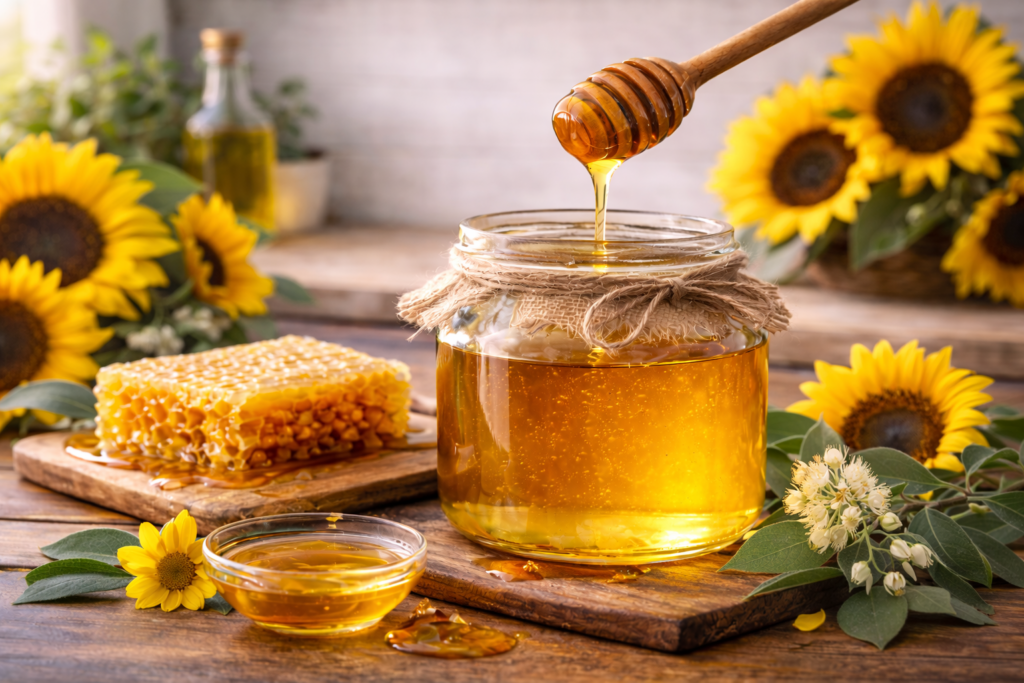
Sunflower honey is usually light to medium in colour with a clean, mildly fruity sweetness. It’s easy to use daily because it doesn’t overpower foods.
In a nutshell: The values provided are approximate and can vary depending on origin, season, and processing.
1) Sunflower Honey
Nutritional facts per 100g (Liquid Honey)
| Nutrient | Amount Per 100g | % Daily Value* |
|---|---|---|
| Calories | 304 kcal | 15% |
| Carbohydrates | 82.4 g | 30% |
| Fiber | 0 g | 0% |
| Sugars | 82.1 g | – |
| Protein | 0.3 g | 1% |
| Fat | 0 g | 0% |
| Vitamin A | 0 IU | 0% |
| Vitamin C | 0.5 mg | 1% |
| Potassium | 52 mg | 1% |
| Calcium | 6 mg | 0% |
Forms of sunflower honey (quick differences)
- Raw / Unfiltered: Calories and sugars stay nearly the same. May contain more pollen and tiny particles.
- Filtered: Calories and sugars stay nearly the same. Clearer and smoother.
- Unpasteurized: Calories and sugars stay nearly the same. Less heat processing.
- Pasteurized: Calories and sugars stay nearly the same. More heat processing and longer shelf stability.
- Crystallized / Creamed: Same nutrition, different texture.
Nutritional facts per 100g (Comb Honey)
Nutrient
Amount Per 100g
% Daily Value*
Calories
295 kcal
15%
Carbohydrates
79.0 g
29%
Fiber
0.2 g
1%
Sugars
78.5 g
–
Protein
0.3 g
1%
Fat
0.1 g
0%
Vitamin C
0.4 mg
1%
Potassium
45 mg
1%
Calcium
6 mg
0%
Pros
- Mild taste, easy daily honey for breakfast and drinks.
- Quick energy in small portion.
- Can replace refined sugar in simple home recipes.
Cons
- High in sugars, so calories add up quickly.
- Easy to overuse because it tastes light.
- Not recommended for infants under 12 months.
Right time to eat
- Morning with breakfast in a small portion.
- Pre-workout in a small portion for quick energy.
- Avoid large servings late night if sweets trigger overeating.
Health benefits
- Helps satisfy sweet cravings with controlled portions.
- Useful as a home sweetener instead of packaged sugary items.
- May feel soothing in lukewarm water for throat comfort.
Best way to eat
- Keep portion small (example: 1 tsp) and treat it like sugar.
- Add to lukewarm water, oats, or curd.
- Pair with protein/fat foods (curd, nuts) for better fullness.
*Percent Daily Values are based on a 2,000 calorie diet.


Join the conversation