
“Consistency is the real technology.” – Wellness Kraft
Introduction
LLLT has a strange reputation online.
One side calls it “science-backed.”
The other side calls it “expensive red light nonsense.”
The truth is less dramatic and more useful: LLLT can help some people, but it’s not a miracle and it’s not for every scalp problem.
Low-Level Laser Therapy uses specific wavelengths of light to stimulate the scalp and follicles. The idea is not “burn the hair into growing.” It’s gentle light energy that may encourage follicles to stay in a healthier growth phase and support thicker growth over time.
But LLLT has two enemies:
- Unrealistic expectations (people want instant results).
- Bad devices and lazy use (people buy random gadgets and use them once a week).
If you treat LLLT like brushing your teeth, it has a chance. If you treat it like a one-time trick, it becomes an expensive hat.
What LLLT Actually Is
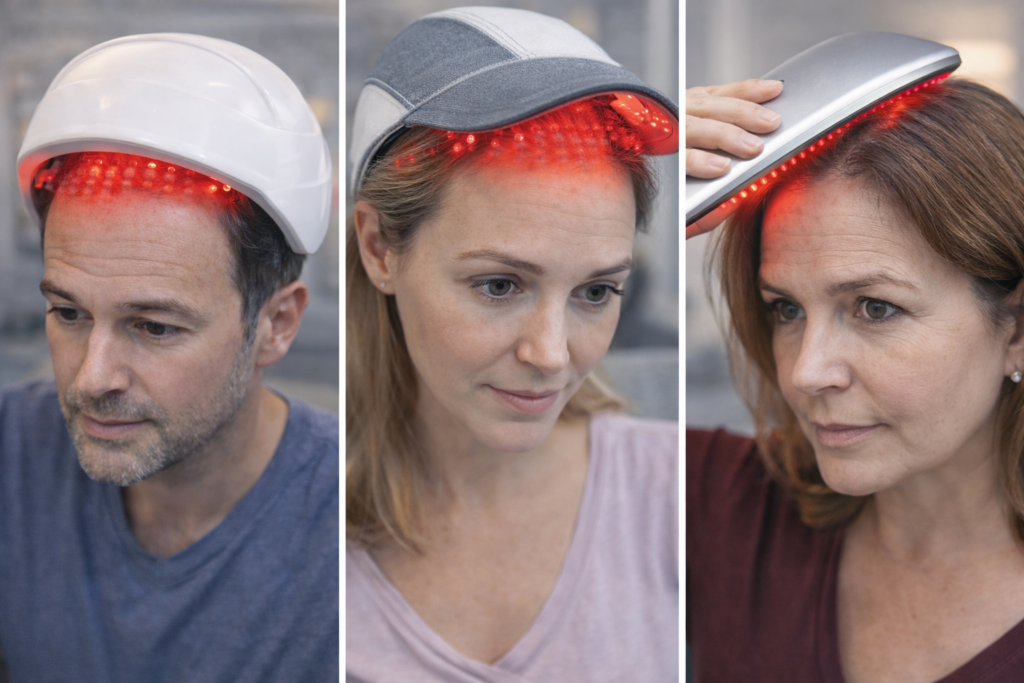
LLLT is also called “red light therapy” or “photobiomodulation” in many contexts. For hair loss, it’s typically delivered through:
- Laser caps or helmets (you wear them for a set time)
- Laser bands (a lighter version)
- Laser combs (you manually move through the hair)
These devices use low-level light that does not heat or damage tissue like high-powered lasers. The goal is stimulation, not destruction.
In plain English: it’s a “nudge,” not a surgery.
How It’s Supposed to Work (Simple Version)
Hair follicles are like tiny factories. In pattern hair loss, those factories gradually downshift. They produce thinner, shorter hairs and spend more time in “rest” phases.
LLLT is thought to support follicles by improving cellular energy activity and local signaling, which may help:
- Extend the growth phase
- Reduce miniaturization pressure (to some degree)
- Improve hair shaft thickness in some users
- Support scalp environment and circulation signaling
Notice the wording: “may help.” LLLT supports the system. It doesn’t override genetics by force.
Who LLLT Helps Most
LLLT is most often discussed for pattern hair loss, where follicles are still alive but struggling.
LLLT tends to be a better bet when:
- Hair loss is mild to moderate (not long-standing severe bald areas)
- Follicles still exist (thinning, not shiny bald scalp)
- You are consistent with use
- You combine it with other proven foundations like minoxidil, finasteride (where appropriate), adequate protein, and scalp health basics
LLLT is usually a poor “standalone rescue plan” for advanced loss. It can’t revive follicles that are already gone.
Also important: if your shedding is from telogen effluvium (stress/illness shedding), LLLT is not always the first priority. TE usually needs trigger management and time. LLLT might be supportive, but it’s not the main fix.
“What Works” vs “What’s Hype”
Let’s separate the helpful from the noise.
What works (in realistic terms)
LLLT works best when you treat it like a long-term routine, not a dramatic intervention.
The people who tend to benefit:
- Use it exactly as prescribed by the device protocol
- Use it consistently for months
- Understand results are subtle, not overnight
- Have early to moderate thinning rather than complete bald patches
- Pair it with a real hair-loss plan, not only gadgets
And a huge practical advantage: LLLT doesn’t rely on your scalp tolerating chemicals. People who can’t tolerate topical solutions sometimes like LLLT because it feels clean and easy.
What’s hype
Here’s the hype version: “Wear this cap and you’ll regrow a full head of hair fast.”
Reality: even when it helps, the improvement is usually gradual and moderate. Many people notice better thickness, less scalp show-through, and improved density in photos, not a total transformation.
Also hype: “Any red light device will do.”
No. Hair-loss devices are designed with specific output and patterns. Random cheap lights that don’t properly reach the scalp or don’t deliver consistent parameters can be useless.
Another hype trap: “Use it more to get faster results.”
Overuse doesn’t always equal better outcomes. Following the schedule matters more than overdoing it.
The Device Quality Problem
LLLT is one of those categories where “looks the same” doesn’t mean “is the same.”
Two caps can look identical and perform very differently. Reasons include:
- Number of diodes (light sources)
- Whether it’s true laser diodes or LED-based systems (both exist; the discussion is nuanced)
- Power output and consistency
- Fit and scalp contact (if it sits too high above thick hair, the scalp may not get enough exposure)
- Build quality (overheating, poor battery, uneven coverage)
This is why LLLT can feel “amazing” for one person and “fake” for another. Sometimes it’s not the concept. Sometimes it’s the device and the usage.
How Often Should You Use LLLT?
Most reputable LLLT hair devices use a schedule like several sessions per week, with each session lasting a set number of minutes. The exact schedule depends on the device.
What matters most: repeatability.
If your schedule is too intense, you won’t stick to it.
If your schedule is too random, you won’t build cumulative effect.
LLLT is a “dose over time” game.
Timelines: When People Actually Notice Changes
This is where expectations usually crash. Hair is slow.
0–8 weeks
Most people feel nothing. Some feel optimistic. Some get frustrated. Some convince themselves it’s not working because they want proof quickly.
2–4 months
Some people start noticing small changes:
- Hair feels slightly stronger or fuller
- Less obvious scalp shine in certain lighting
- Styling becomes a bit easier
But it’s not always dramatic.
4–6 months
This is often when you can better judge if it’s doing something:
- Photo comparisons look different
- Density improvements become more noticeable
- The “overall look” improves even if you still have thinning
6–12 months
This is the real window to judge LLLT properly. People who benefit usually say, “It’s subtle, but it’s real.”
If you stop too early, you often stop before you can see it.
A Real-Life Story That Explains LLLT Perfectly
Lauren noticed her part line widening over two years. It wasn’t sudden shedding. It was slow thinning. She tried every shampoo trend, and nothing changed because the issue wasn’t shampoo-level.
She started a proper plan and added LLLT because she wanted a non-messy supportive step she could stick to. She used the cap on schedule while watching TV at night. It wasn’t hard. That was the point.
At month two, she felt impatient. At month four, she noticed her hair looked better in photos. Not “new hair everywhere,” but less scalp show-through. At month six, she realized styling was easier and the part line looked calmer.
Her biggest win was not the cap alone. It was how the cap made consistency easier. It became her routine anchor. And when you anchor the routine, you stop bouncing between desperate experiments.
LLLT didn’t “save” her hair in one move. It supported her long-term plan.
That is how LLLT wins.
Safety: Is LLLT Safe?
LLLT is generally considered low-risk for many people when used as directed. It’s non-invasive and doesn’t involve systemic medication.
But “low-risk” doesn’t mean “no rules.”
Things to be careful about:
- Don’t use a device that overheats or irritates your scalp
- Don’t use it on active scalp infections or open wounds
- If you have a scalp condition like severe dermatitis or psoriasis flare, get it controlled first
- If you’re using photosensitizing medications or have a medical condition affecting light sensitivity, speak with a clinician
Also, if you have hair loss that is scarring/inflammatory, you need a dermatologist. Gadgets should not be the first response to a scalp that is inflamed and actively damaging follicles.
How to Combine LLLT With Other Treatments
LLLT usually performs best as part of a “stack” that makes sense, not a messy pile of random things.
A practical, calm plan looks like:
- A proven baseline for pattern hair loss (as appropriate to your case)
- Gentle scalp care (reduce irritation and inflammation)
- LLLT as a consistency-friendly add-on
- Nutrition that supports growth (adequate protein, iron status checked if relevant)
- Patience and photo tracking every two weeks, not daily obsession
LLLT can be especially attractive for people who can’t tolerate topical products or who want a non-drug supportive option.
Key Takeaways
- LLLT can help some people with pattern hair loss, especially mild to moderate thinning.
- It’s usually slow and subtle, not an overnight transformation.
- Device quality and consistent use matter more than “trying harder.”
- Expect to judge results over 6–12 months, not weeks.
- LLLT is best used as an add-on to a solid plan, not as a lone rescue strategy.
Research Insight
Studies and medical references discuss LLLT as a non-invasive option for androgenetic alopecia, with several clinical trials reporting improvements in hair density and thickness in some users when devices are used consistently over time. The literature also emphasizes that results vary, protocols differ, and benefits are often modest but meaningful for the right candidates.
Links:
https://pmc.ncbi.nlm.nih.gov/articles/PMC3944668/
https://pubmed.ncbi.nlm.nih.gov/24078483/
https://pubmed.ncbi.nlm.nih.gov/23970445/
https://pubmed.ncbi.nlm.nih.gov/28981284/
https://www.aad.org/public/diseases/hair-loss/treatment/laser-combs
FAQs
1) Is LLLT actually effective or just placebo?
It can be effective for some people, especially with pattern hair loss, but it’s not a guaranteed result for everyone. The improvement is usually gradual and moderate. Many people who benefit describe it as “my hair looks fuller and healthier,” not “I got my teenage hairline back.”
2) How long should I try LLLT before deciding it’s not working?
Most people should give it at least 6 months of consistent use, because hair cycles are slow. If you stop at 6–8 weeks, you’re basically quitting before the story even starts.
3) Can LLLT replace minoxidil or finasteride?
For some people who can’t tolerate other treatments, LLLT can be a supportive alternative, but it’s usually better as an add-on rather than a replacement. If you’re dealing with active pattern loss, a clinician-guided plan often gives the strongest results.
4) Are laser caps safe for everyone?
They’re low-risk for many people when used correctly, but you should avoid using them over active infections, open wounds, or uncontrolled inflammatory scalp conditions. If you have light sensitivity issues or take medications that increase sensitivity to light, discuss with a clinician.
5) Why do some people say LLLT “did nothing”?
Most commonly: inconsistent use, unrealistic expectations, advanced hair loss where follicles are already gone, or low-quality devices that don’t deliver effective exposure to the scalp. LLLT is a consistency game, and it’s not designed to resurrect completely bald areas.
Concluding Thoughts
LLLT is not a scam. It’s also not a miracle.
It’s a slow, consistent support tool that can improve hair density for some people, especially when hair follicles are still present and struggling rather than completely gone. If you want a low-drama, non-messy addition to a hair-loss plan, LLLT can make sense.
Just don’t buy it for the fantasy. Buy it for the habit: small sessions, repeated often, for long enough to let biology respond.




Join the conversation