
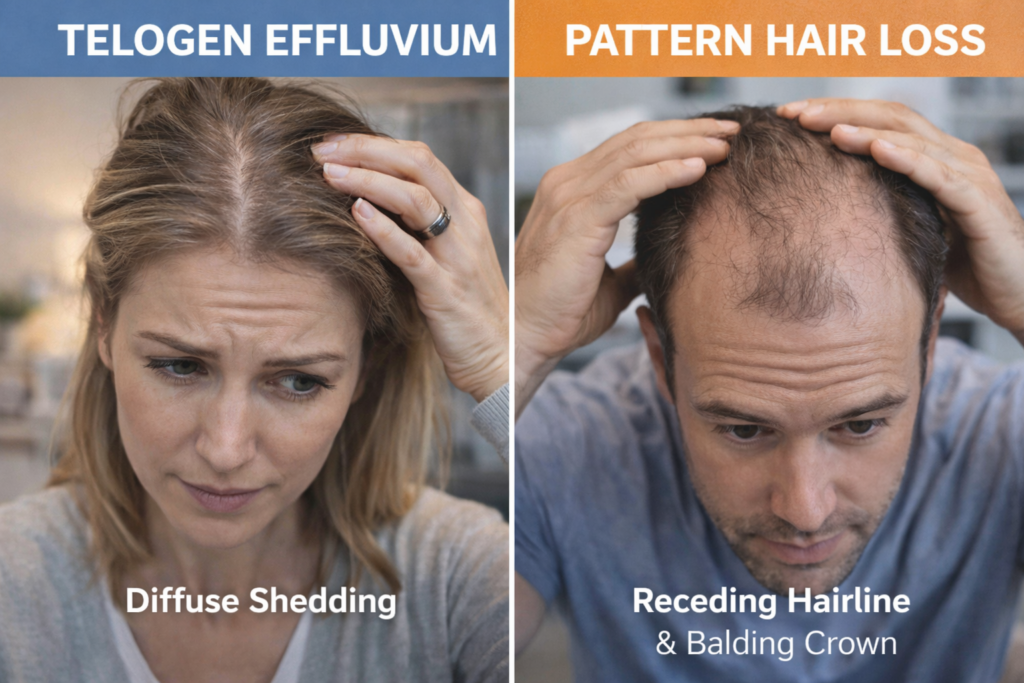
“Before you assume the ending, read the signals.” – Wellness Kraft
Introduction
Let’s talk about the moment it usually starts.
You notice the drain. Or your ponytail feels thinner. Or the part line looks wider in certain lighting. And then your brain does something very human: it tries to solve the whole mystery in one night.
You search online. You compare photos. You tug at hair. You check angles. You replay the last few months like a detective. You wonder if stress did it. You wonder if food did it. You wonder if it’s permanent.
Here’s the problem: hair loss is a symptom, not a single disease. And two of the most common causes can feel similar in the beginning but behave very differently over time.
Telogen Effluvium (TE) is usually a temporary shedding reaction. Think of it like the body hitting “pause” after a shock.
Pattern Hair Loss (Androgenetic Alopecia, AGA) is usually a gradual thinning pattern. Think of it like follicles slowly changing their output over time.
The point of this article is not to diagnose you through a screen. The point is to help you stop guessing blindly. Because when you understand the difference, you stop wasting months on the wrong approach, and you stop feeding the panic loop.
First, Understand the Big Difference: Shedding vs Thinning
This one distinction clears up a lot.
Telogen Effluvium is usually more shedding. You see more hair coming out.
Pattern Hair Loss is usually more thinning. You may not notice dramatic shedding, but the density slowly reduces.
In real life, people often experience both, and that’s where the confusion explodes. TE can make you shed suddenly, and underneath that, early pattern thinning might also be present. So yes, it can be mixed. But even in mixed cases, you can usually identify which one is driving the current crisis.
What Telogen Effluvium Usually Looks Like
Telogen Effluvium is often described as “diffuse shedding.” That means hair comes out from all over rather than one clear bald patch. You may feel like your hair is everywhere, and the volume feels reduced.
Common ways TE shows up:
You notice more hair in the shower and brush than usual.
You notice strands on your pillow or clothes.
Your overall hair feels thinner or lighter, but the hairline usually stays fairly intact.
You may see lots of shorter “baby hairs” later as regrowth starts.
The emotional pattern of TE is intense because it feels sudden. Many people can point to a time when it began, even if they cannot understand why.
The “delay” that confuses people
One reason TE freaks people out is that it often begins after the triggering event, not during it.
You may have had a fever, a major stress period, surgery, a big weight change, postpartum changes, stopping or starting a medication, or even a nutritional deficiency. Then your hair starts shedding later, and you think, “But that was months ago. I’m fine now.”
Hair is slow to react. It moves on its own timeline.
Common triggers that can set off TE
This is not a complete list, but these are frequent suspects:
Major illness or fever
Surgery or significant physical stress
Postpartum changes
Rapid weight loss or strict dieting
Severe emotional stress (especially prolonged)
Iron deficiency or low ferritin
Thyroid imbalance
Certain medications (a clinician can help identify these)
The important point is this: TE is often the scalp’s way of reacting to a “body event.” Sometimes the trigger is obvious. Sometimes it’s subtle and only shows up in bloodwork.
What Pattern Hair Loss Usually Looks Like
Pattern hair loss is typically slower and more predictable in how it spreads.
In many men, it often starts with:
Thinning at the temples and hairline
Thinning at the crown (vertex)
Gradual change over time rather than sudden shedding
In many women, it often looks like:
Diffuse thinning over the crown
Widening part line
Reduced density while the frontal hairline is often preserved
Pattern hair loss can feel sneaky because it does not always come with dramatic shedding. The hair may still shed, but the bigger issue is that the hair growing back becomes finer over time. That change in thickness is what makes the scalp more visible.
The “miniaturization” clue
Pattern hair loss tends to cause follicles to produce thinner, shorter hairs. Over time, the thickness variation becomes noticeable. You may see a mix of thicker hairs and finer hairs in the same area.
People describe it like this:
“My hair didn’t just fall. It changed.”
That’s a very pattern-loss sentence.
A Simple Self-Check: What Does Your Hairline Say?
Hairline behavior matters.
TE usually does not create a classic receding hairline on its own. It can reduce density and make everything look flatter, but it does not typically carve out the temples in a deliberate, progressive pattern.
Pattern hair loss often does.
So ask yourself:
Is my hairline changing shape?
Are my temples looking more “cut back” than before?
Is the crown getting more visible in photos?
If yes, pattern loss becomes more likely.
If the hairline shape is mostly the same but everything feels like it’s shedding more than usual, TE becomes more likely.
Another Self-Check: Is It “All Over” or “Mostly Here”?
TE: often “all over the scalp” and feels like volume loss everywhere.
Pattern hair loss: often concentrates in typical zones (temples/crown for men, part/crown for women).
This doesn’t mean TE can’t look worse in one area. Lighting and styling can make one zone look dramatic. But the overall behavior tends to be more evenly spread.
The Shower-Drain Question Everyone Asks
“Is it normal to lose this much hair?”
It’s normal to shed hair every day. What matters is the change from your baseline.
If your shedding suddenly doubled or tripled compared to your normal, something shifted. That “something” can be TE, and it can feel terrifying because it happens fast. But fast is also a clue: pattern hair loss usually does not change overnight.
A Story That Might Sound Familiar
Chris is 33. He had a rough few months: high workload, poor sleep, and a bad viral illness that knocked him out. By the time he felt normal again, he thought the chapter was closed.
Then the shedding started.
He noticed it first in the shower. Then on his desk. Then in his hoodie. He started checking his hair under bright light. He started touching his scalp more. He started taking photos from angles he never cared about before.
His mind jumped to “I’m going bald.”
But here’s what stood out: his hairline shape looked mostly the same. His temples didn’t look carved out. The shedding was coming from everywhere. And when he looked back, the timing matched that illness and the months of stress.
Chris didn’t need a miracle oil. He needed a timeline, some basic labs, and a plan that focused on recovery and patience.
This is the emotional trap: TE feels like a disaster because it moves fast. But fast is often the reason it’s reversible.
The “Both Can Happen” Reality
Many people have mild, early pattern thinning they never noticed. Then a TE episode hits and suddenly everything looks worse. It’s like turning on bright lights in a room you never inspected.
TE can “unmask” pattern hair loss.
This is why some people recover partially but not fully. The shedding slows, but density doesn’t return to the exact old baseline because there was underlying thinning already starting.
This is also why it’s smart to evaluate rather than assume.
What a Dermatologist Looks For
A proper evaluation is not only “look at hair and guess.”
Clinicians may use:
A detailed history (stressors, illness, meds, postpartum changes, diet changes)
Scalp exam for pattern distribution
Hair pull test (how easily hairs come out)
Dermatoscopy/trichoscopy (magnified look for miniaturization and hair diameter variation)
Sometimes basic labs (iron/ferritin, thyroid, vitamin status, depending on context)
You do not need to fear the appointment. The goal is clarity.
What You Can Do Right Now, Before Any Treatments
Whether it is TE or pattern loss, the first phase is the same: stop making it worse.
Stop aggressive “DIY experiments”
When people panic, they start stacking oils, scrubs, new shampoos, supplements, scalp devices, and harsh routines. The scalp gets irritated, hair breaks more easily, and the person confuses breakage with shedding.
Keep hair care gentle for now:
Avoid tight hairstyles and heavy traction
Avoid harsh chemical treatments during active shedding
Use mild shampoo, don’t over-scrub the scalp
Detangle gently, especially when wet
Separate shedding from breakage
Shedding: you see full strands with a tiny bulb at the end sometimes.
Breakage: you see shorter pieces, frayed ends, more “snap.”
Breakage has different causes and needs different fixes.
Track intelligently, not obsessively
Take one clear photo:
Same place, same lighting, same angle, once every two weeks.
Not daily. Daily photos create anxiety and false conclusions.
Treatment Direction: TE vs Pattern Hair Loss
If it’s Telogen Effluvium
The core approach is:
Identify and address the trigger if possible.
Support recovery: sleep, nutrition, stress management, iron/thyroid evaluation if relevant.
Give time for the cycle to stabilize.
Many TE cases improve gradually once the body recovers. The hardest part is psychological: TE makes you feel like you’re losing control. But the scalp often catches up when the system calms down.
If shedding continues for a long time, or keeps repeating, you need evaluation for chronic TE and underlying causes.
If it’s Pattern Hair Loss
Pattern loss is typically managed with evidence-based treatments and consistency.
This often includes topical treatments like minoxidil, and in some cases prescription options depending on sex, age, medical history, and clinician guidance. The most important idea is that pattern loss responds to long-term consistency, not quick fixes.
Pattern loss is not usually solved by “one shampoo” or “one supplement.” It requires a plan.
If it’s both
Treat the TE trigger and also consider starting a pattern-loss plan if signs of miniaturization and pattern thinning are present. Many people do best when both are addressed properly rather than choosing only one story.
When Hair Loss Needs Urgent Attention
Not all hair loss is TE or pattern loss.
Seek evaluation sooner if you notice:
Patchy bald spots
Scalp pain, burning, crusting, heavy scaling, or pus
Sudden eyebrow or eyelash loss
Rapid loss with systemic symptoms (fatigue, weight changes, fever)
Scarring or shiny scalp areas
Hair loss in a child
Those patterns can signal other conditions that need timely care.
Key Takeaways
- Telogen Effluvium is typically a diffuse shedding reaction, often after a stressor, and is often temporary.
- Pattern Hair Loss is typically gradual thinning in a predictable distribution and may involve hairs becoming finer over time.
- TE is usually more about “hair coming out.” Pattern loss is usually more about “hair coming back thinner.”
- Hairline shape change and part-line widening are strong clues for pattern loss.
- TE can unmask early pattern thinning, so mixed cases are common.
- If shedding is heavy, prolonged, patchy, painful, or associated with other symptoms, get evaluated.
Research Insight
Authoritative dermatology and medical references describe Telogen Effluvium as a common cause of diffuse shedding that often follows a physical or emotional stressor and may begin after a delay, with many cases improving over time once the trigger resolves.
https://www.aad.org/public/diseases/hair-loss/insider/shedding
https://dermnetnz.org/topics/telogen-effluvium
https://my.clevelandclinic.org/health/diseases/24486-telogen-effluvium
https://www.ncbi.nlm.nih.gov/books/NBK430848/
https://www.bad.org.uk/pils/telogen-effluvium
Medical references describe Pattern Hair Loss (androgenetic alopecia) as a gradual, predictable thinning pattern that differs between men and women and is associated with follicle miniaturization over time.
https://www.ncbi.nlm.nih.gov/books/NBK430924/
https://medlineplus.gov/genetics/condition/androgenetic-alopecia/
FAQs
1) How can I tell TE from pattern loss at home?
Start with behavior and timeline. TE usually feels like a sudden shedding surge and often follows a stressful event, illness, weight change, postpartum shift, or medication change. Pattern loss usually shows gradual thinning in typical zones, like temples and crown or widening part line, often over many months. If you can’t tell, that is normal, and a dermatologist can help by looking for miniaturization patterns and checking your history.
2) Does TE always grow back completely?
Many cases improve significantly once the trigger resolves, but “completely” depends on whether there is underlying pattern thinning, nutritional deficiency, thyroid imbalance, or ongoing stress. TE can also be chronic in some people. If shedding lasts a long time or keeps returning, get evaluated for chronic TE and underlying factors.
3) Can stress alone cause TE?
Yes, prolonged or severe stress can be a trigger for TE, especially when it disrupts sleep, appetite, and overall physiology. But it’s often not “stress alone.” Stress may combine with illness, poor nutrition, iron deficiency, or hormonal changes. That’s why a basic check of common contributors can be useful if shedding is persistent.
4) Why does my hair look thinner even if I’m “only shedding”?
When shedding increases, your overall density drops, so your scalp becomes more visible and your ponytail feels smaller. That can look like thinning even if follicles are still healthy. TE is often a density shock. Pattern loss is often a density and hair-thickness change over time. Both can make hair look thinner, but the pattern and timeline differ.
5) When should I see a dermatologist instead of waiting?
If shedding is heavy and persistent, if you see patchy bald spots, if there’s scalp pain or inflammation, or if you’re seeing clear pattern changes (rapid crown visibility or hairline recession), it’s worth getting evaluated. Also seek help if hair loss is affecting your mental health, because that matters too and often worsens the stress cycle.
Concluding Thoughts
Hair loss panic is understandable because hair feels like identity. But your next step should not be panic-driven experimentation. Your next step should be pattern recognition.
If the loss is sudden and diffuse, think Telogen Effluvium and look back for triggers, even if they happened months earlier. If the loss is gradual and concentrated in typical zones, think Pattern Hair Loss and consider a long-term plan. And if it looks like both, don’t force a single explanation. Mixed cases are common and manageable.
The best outcome usually comes from one decision: stop guessing and start observing the right clues.




Join the conversation