
“Pick clarity over panic, and consistency over confusion.” – Wellness Kraft
Introduction
When people start noticing pattern hair loss, they usually try the soft options first: oils, shampoos, vitamins, scalp scrubs. Those can be supportive for scalp health, but they rarely stop true pattern thinning because pattern thinning is not mainly a “hair quality” issue. It’s a follicle miniaturization issue.
Finasteride is one of the few treatments that addresses that miniaturization pathway by lowering DHT (dihydrotestosterone), the hormone that can gradually shrink follicles in genetically sensitive scalp areas. When DHT is reduced, follicles are less pressured to miniaturize, which often helps slow loss and, for many people, improves density over time.
But finasteride has a loud reputation online. Some treat it like a miracle. Others treat it like a monster. Both extremes create the same problem: people either jump in blindly or avoid it completely, even when it could help.
So let’s make this practical. What’s the difference between topical and oral finasteride, how effective are they, what are the real risks, and how do you choose without spiraling?
What Finasteride Does
Finasteride reduces DHT by blocking an enzyme that converts testosterone into DHT. Lower DHT means less DHT activity at the follicle, especially in the scalp zones prone to pattern hair loss.
That’s why finasteride is not a “growth stimulant” like caffeine for hair. It’s more like turning down the signal that tells follicles to shrink. You’re trying to protect the follicles from ongoing miniaturization, so your hair has a chance to stay thicker for longer.
This is also why finasteride is usually described as a maintenance-first treatment. Many people get visible improvement, but the biggest win is often stopping the slow slide.
The Core Difference
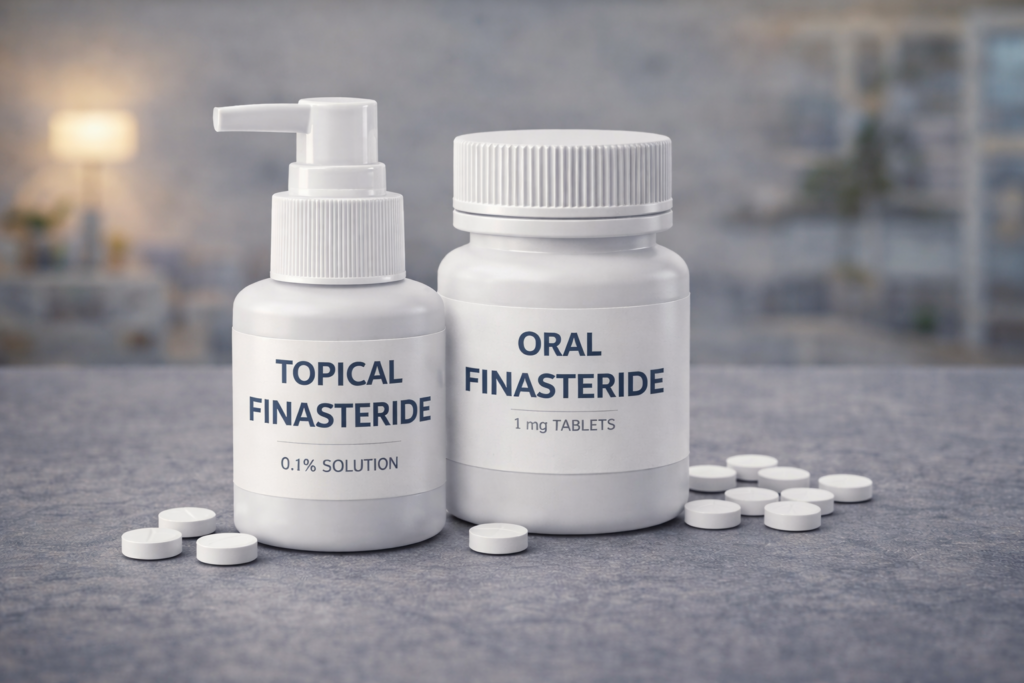
Oral finasteride is systemic by design. You swallow it, it circulates through your body, and it lowers DHT throughout the system.
Topical finasteride is local by intention. You apply it to the scalp, aiming to concentrate action where you need it. But “local” does not mean “zero systemic.” Skin can absorb medication. Some topical finasteride can still enter the bloodstream and lower DHT beyond the scalp, depending on the dose, formula, and how your body responds.
So the difference is not “systemic vs non-systemic.”
The difference is “more standardized systemic exposure vs potentially reduced systemic exposure, but variable.”
Effectiveness: What People Really Want to Know
Oral finasteride
Oral finasteride is widely used for male pattern hair loss and is generally effective at slowing progression and improving hair measures in many users when taken consistently. The key word is consistent. Hair responds slowly, and the biggest mistake people make is judging too early or stopping too quickly.
In plain terms, oral finasteride is the “known road.” The dose is standardized, the routine is simple, and clinical experience is deep.
Topical finasteride
Topical finasteride can also be effective. Some studies and clinical use suggest it can improve hair measures, and for some people it may provide benefits with potentially different systemic exposure compared to oral.
The biggest practical issue with topical is not whether it can work. It’s that topical is not always one consistent product. Many topical versions are compounded, meaning different concentrations and different vehicles can change absorption. Two people can say “I used topical finasteride” and be talking about two completely different realities.
So yes, topical can be effective. But the “what exactly are you using” question matters more with topical than it does with oral.
Risk Trade-Offs: What You’re Actually Choosing
Oral finasteride risks
Because oral finasteride is systemic, potential side effects can also be systemic. The concerns people discuss most often include sexual side effects (like changes in libido, erectile function, or ejaculation) and mood-related changes in a smaller subset of users. Not everyone experiences these. Many people do fine. But the possibility is real enough that you should take it seriously, monitor yourself, and not dismiss symptoms if they show up.
Topical finasteride risks
Topical finasteride is often chosen because people want to reduce systemic exposure. That can be a reasonable goal. But it’s important to stay honest: topical can still absorb. Some users report systemic-type effects even with topical. Also, topical formulas can sometimes irritate the scalp depending on the base (for example, alcohol-heavy solutions) or if they’re combined with other actives.
So topical is not “risk-free.” It’s “possibly a different risk profile,” and the profile depends heavily on dose and formulation.
The Biggest Myth
“Topical finasteride has no side effects because it stays on the scalp.”
This is the myth that causes both confusion and disappointment.
Some people start topical expecting zero systemic impact. Then they notice a change in how they feel and panic because they were told it was impossible. The truth is simpler: skin absorption can happen. The goal with topical is usually to reduce systemic exposure, not guarantee none.
If you start with realistic expectations, you stay calm and make better decisions.
The Compounding Problem: Why Topical Feels Inconsistent Online
A big reason you’ll see wildly different topical finasteride experiences is that many products are not identical.
One person uses a carefully formulated topical with a specific concentration and dosing schedule. Another person uses a stronger compounded mix, maybe combined with minoxidil, maybe with penetration enhancers, maybe with a base that changes absorption. Their results and side effects can differ dramatically.
This is why topical finasteride requires more “product awareness” than oral. With oral, the tablet is usually the tablet. With topical, the formulation is part of the treatment.
A Story That Sounds Like Real Life
Ryan noticed his crown thinning in photos. He started searching. He found two loud internet camps.
Camp one said oral finasteride is the only serious option.
Camp two said oral finasteride is dangerous and topical is the safe loophole.
Ryan did what most people do. He tried to pick the option that reduced his anxiety, not the option that matched his situation.
He started topical because it felt emotionally safer. But he became hyper-alert to every sensation. A stressful week felt like a side effect. A tired day became suspicious. His anxiety became louder than the hair plan.
Eventually, he sat with a dermatologist who did something simple but powerful: they turned the decision into a monitored plan.
They discussed his baseline health, his fears, his lifestyle, and what “success” would realistically look like. Ryan learned that the best treatment is the one he can take consistently without living in fear.
His biggest improvement wasn’t just hair. It was peace.
That’s the part people miss. Stress doesn’t just feel bad. It can wreck consistency, and consistency is the entire game in hair recovery.
How to Choose Without Regret
If you want a clean way to decide, ask yourself these questions.
Can I realistically follow a daily topical routine, long-term, without skipping?
If not, oral may be more sustainable simply because it’s easier to do daily.
Do I have high anxiety about systemic medications?
If yes, topical might be emotionally easier to start, as long as you remember “lower systemic” is not “zero systemic.”
Do I want the most standardized option with the most routine clinical track record?
If yes, oral is usually the more standardized path.
Have I had side effects from oral before and want another approach?
If yes, topical might be worth discussing as a different exposure strategy.
Do I have a household pregnancy risk where handling precautions matter?
Then you need strict safety habits, especially around crushed or broken tablets, and you should discuss exposure handling with a clinician.
The best choice is not the one that wins an internet argument. It’s the one you can do calmly for a long time.
Key Takeaways
- Finasteride targets DHT-driven miniaturization, which is why it’s considered a root-cause treatment for pattern hair loss.
- Oral finasteride is standardized and systemic. Topical finasteride aims to be scalp-focused but can still absorb into the bloodstream.
- Both can be effective, but topical outcomes depend heavily on formulation quality, concentration, and consistency.
- Side effects are possible with both routes. Most people tolerate finasteride, but monitoring matters, and symptoms should never be ignored.
- Hair results take time. Consistency over months matters more than guessing week to week.
Research Insight
Oral finasteride (commonly 1 mg/day for male pattern hair loss) has strong evidence for slowing progression and improving hair measures when used consistently.
https://www.jaad.org/article/S0190-9622%2898%2970007-6/abstract
https://pmc.ncbi.nlm.nih.gov/articles/PMC6609098/
Topical finasteride has clinical evidence supporting efficacy, with studies showing improvements versus placebo and discussion of systemic DHT effects depending on formulation and dose.
https://pmc.ncbi.nlm.nih.gov/articles/PMC9297965/
https://pmc.ncbi.nlm.nih.gov/articles/PMC10239632/
Regulatory and safety discussions highlight the need for monitoring and informed consent, especially around adverse event reporting and topical/compounded product variability.
https://www.health.com/telehealth-companies-topical-propecia-finasteride-fda-11726649
https://www.reuters.com/business/healthcare-pharmaceuticals/eu-drugs-regulator-confirms-suicidal-thoughts-side-effect-anti-hair-loss-drug-2025-05-08/
Official labeling includes pregnancy-related handling warnings for finasteride tablets.
https://www.accessdata.fda.gov/drugsatfda_docs/label/2012/020788s020s021s023lbl.pdf
FAQs
1) Is topical finasteride as effective as oral finasteride?
It can be effective, and some studies suggest strong results, but topical effectiveness depends heavily on the formulation, concentration, and consistent use. Oral is more standardized. Topical can vary more, especially if it’s compounded.
2) Does topical finasteride completely avoid side effects?
No. Topical aims to reduce systemic exposure for some people, but absorption can still occur. Some users report systemic-type side effects with topical too. The honest expectation is “possibly lower systemic exposure,” not “zero systemic impact.”
3) How long does finasteride take to show results?
Hair cycles move slowly. Most people need months of consistent use to judge progress. Early panic-stopping is one of the biggest reasons people feel like nothing works.
4) Can finasteride affect mood or mental health?
Mood-related adverse effects have been reported. If you notice depression symptoms, anxiety spikes that feel unusual, emotional flattening, or dark thoughts after starting, treat it seriously and contact your prescriber promptly.
5) If I stop finasteride, will I lose the hair I gained?
Finasteride generally helps maintain hair while you keep using it. If you stop, benefits often fade gradually over time and hair may return toward the pattern it would have followed. If you’re considering stopping, discuss a transition plan with a clinician.
Concluding Thoughts
The topical vs oral finasteride debate becomes exhausting when it’s driven by fear. Both options can work. Both require consistency. Both deserve respect.
Oral finasteride is the most standardized route. Topical finasteride can be a reasonable alternative, especially for people who struggle with oral tolerance or want a different exposure strategy, but it’s not automatically side-effect-proof and the product details matter.
The best plan is the one you can follow calmly for the long term, with proper guidance and monitoring.




Join the conversation