
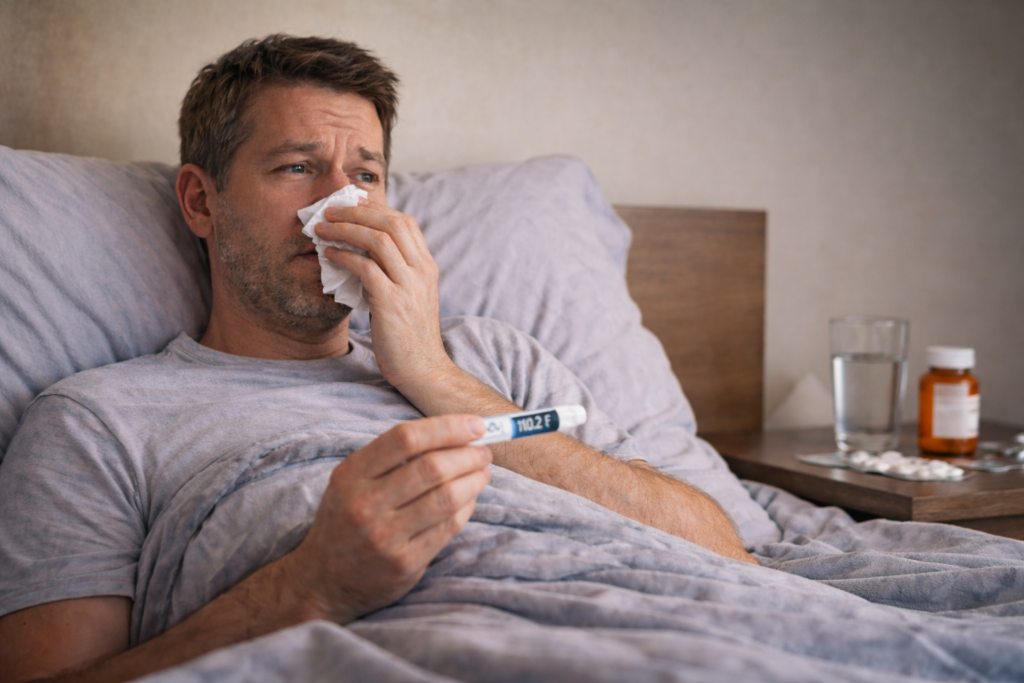
“Recovery isn’t laziness. It’s a repair.”
– Wellness Kraft
Introduction
The “man flu” joke usually goes like this: a man gets a cold and suddenly behaves like he’s been personally attacked by the universe.
But if we stop laughing for five seconds, something important shows up.
A lot of men don’t just feel sick; they feel knocked out. Heavy. Foggy. Irritable. Like their brain has been wrapped in wet cotton. And when they try to push through the way they go through everything else, it often backfires. They don’t recover faster. They recover messier. They get “better” for a day, then crash again. Or they carry a cough for three weeks and pretend that’s normal.
So instead of asking, “Are men dramatic?” a smarter question is:
Why do so many men get stuck in the same recovery trap?
Because once you understand the trap, you can avoid it.
What “Man Flu” Really Means
Most people mix two different things:
Symptom intensity
How strongly your body experiences fever, aches, congestion, and fatigue.
Illness behavior
How you act when you’re sick: whether you rest, whether you hydrate, whether you keep working, whether you treat sleep like optional.
The joke focuses on behavior. The honest answer lives in both.
The Biology Part
Men and women can differ in immune responses. That doesn’t mean one is “stronger” in every situation. It means immune systems are tuned differently based on hormones, genetics, and how inflammation gets regulated.
What this can look like in real life:
- Some men may experience certain viral illnesses with a higher risk of complications.
- Some women may mount stronger immune responses that clear infections effectively, but those stronger responses can also be associated with greater inflammation in some contexts.
- Symptom experience can differ even when two people have the same virus.
The key point: biology may influence the baseline.
But biology doesn’t explain the whole “why am I still sick?” story.
The Lifestyle Part
If you wanted to design a slow recovery, modern life would volunteer as tribute.
Sleep debt
Sleep is not comfort. Sleep is immune coordination. During quality sleep, your body runs repair processes and balances inflammatory signals. When sleep is short or broken, you’re basically asking your immune system to fight with a low battery and poor Wi-Fi.
Men often get hit here because many run on:
- late nights and early mornings
- heavy screen exposure before bed
- alcohol close to bedtime
- irregular sleep schedules
- “I’ll catch up on the weekend” (which rarely fixes the whole week)
Stress overload
Stress doesn’t just make you “feel bad.” It keeps your nervous system activated. When your nervous system stays on high alert, your body prioritizes survival over repair.
That’s why some illnesses feel louder when life is noisy. Your immune system is trying to work while your mind is still sprinting.
Dehydration and under-fueling
When you’re sick, your appetite drops. Hydration drops. Then headaches increase, fatigue increases, mucus thickens, sleep worsens, and the whole thing becomes a loop.
A lot of men unintentionally do this:
- skip fluids
- skip meals
- keep caffeine high
- wonder why the body feels weak and shaky
That’s not only the virus. That’s the environment you’re giving the virus.
Why Men Often Feel Like They Get Hit Harder
Here are the common “real-life” reasons men feel wiped out even by “simple” infections:
They wait too long to slow down
Many men don’t rest at the early warning stage. They rest at the collapse stage. So by the time they finally stop, they’re already deeper into inflammation and fatigue.
Their “rest” isn’t actually rest.
This is the sneaky one.
Lying down while:
- answering work messages
- scrolling bad news
- worrying about deadlines
- playing competitive games
- staying on bright screens at 1:00 AM
is not rest.
It’s your body horizontal, but your nervous system is still at work.
Real rest reduces stimulation. It creates quiet. It lets the body run recovery without interruption.
They try to “sweat it out.”
Hard workouts while sick can backfire for many people. Sometimes light movement helps. Heavy training often adds stress load at the exact time your body is already taxed.
If you want a short illness, you don’t add extra battles.
A Real-World Scenario Without the Label
Mike is 36. He’s generally healthy and proud of being reliable. When he gets sick, he doesn’t take time off. He “powers through.”
It starts with a scratchy throat. He ignores it. He sleeps late because he’s finishing something on his laptop. He wakes up tired and hits caffeine harder. By day two, he’s congested and achy. He still works. He still scrolls. He still stays up late because he feels behind. He tells himself he’s resting because he’s on the couch.
By day four, he’s frustrated: “Why am I not getting better?”
The truth is simple: Mike didn’t just catch a virus. He built the perfect conditions for slow recovery:
- short sleep
- constant stimulation
- dehydration
- stress loops
- no true downtime
When he finally takes one full day and treats it like recovery is the job, things shift:
- he sleeps earlier
- drinks fluids consistently
- eats simple, steady meals
- stops screens at night
- reduces work stress
And suddenly the illness stops dragging.
Same virus. Different recovery strategy.
How To Recover Faster
This is the part that makes the joke irrelevant.
The first 24–48 hours
These two days often decide whether you bounce back quickly or drag it out.
- Sleep like it’s medicine.
Earlier bedtime. Dark room. Phone away. Your body needs uninterrupted repair time. - Hydrate consistently
Not one big bottle. Small, regular fluids. If you’re sweating or feverish, add electrolytes. - Eat steadily and straightforwardly.
Soups, protein, fruit, and easy carbs. Don’t force “perfect diet.” Just give your immune system fuel. - Lower stimulation
Your immune system heals best when your nervous system is not constantly triggered. Reduce late-night scrolling and work messages. - Skip the hero workout.
If you must move, keep it gentle. Save intensity for after you’re truly better.
The mindset shift
A lot of men try to “win” against sickness by refusing to slow down.
The more brilliant move is efficiency: slow down early so you don’t lose a week.
When To Get Medical Help
Most colds resolve. But specific symptoms should not be handled with jokes or toughness:
Seek medical advice promptly if you have:
- Trouble breathing or chest pain
- Fainting, confusion, severe weakness
- Dehydration, you can’t correct
- A fever that is persistent or very high
- Symptoms that improve, then suddenly worsen
- You’re in a higher-risk group for flu complications due to underlying conditions
The goal is not panic. The goal is not to ignore something that needs attention.
Key Takeaways
- “Man flu” is a poor label for a real mix of biology, stress, and recovery habits.
- Sleep and stress strongly influence how sick you feel and how long recovery takes.
- Many men recover more slowly because they stay up late, and their “rest” stays mentally noisy.
- Early recovery often shortens the total illness time.
- Red-flag symptoms should be treated seriously, not brushed off.
Research Insight
Researchers have documented sex-based differences in immune responses and infection outcomes, influenced by factors such as hormones and genetics, which can affect susceptibility and symptom experience. Nature+1
A widely discussed BMJ review explored the “man flu” idea. It summarized evidence suggesting men may have different immune responses and outcomes for certain respiratory viral infections, while also noting the limits of available data. BMJ+1
High-quality human research has linked shorter sleep duration and poorer sleep efficiency with increased susceptibility to developing a clinical cold after viral exposure, supporting sleep as a real lever for immune resilience. PMC+1
Public health guidance explains when influenza can become serious and highlights who is at higher risk for complications and should seek care earlier. CDC+1
Links:
https://www.bmj.com/content/359/bmj.j5560
https://www.nature.com/articles/s41577-020-0348-8
https://pmc.ncbi.nlm.nih.gov/articles/PMC2629403/
https://www.cdc.gov/flu/highrisk/index.htm
FAQs
1) Is “man flu” real or just an exaggeration?
The label is a joke, but the underlying question has real layers. Research shows biological sex can influence immune response patterns, which may affect how symptoms are experienced and how risks differ in some infections. At the same time, behavior often matters even more: sleep, stress, hydration, and how early you rest can turn the same virus into a quick recovery or a long drag.
2) Why do I feel destroyed by a typical cold?
Often, it’s not only the virus, but it’s also your baseline. If you’re already underslept, stressed, dehydrated, and running on caffeine, the immune response can feel louder: more fatigue, more aches, more brain fog. Illness becomes the final straw, not the only problem.
3) What’s the biggest recovery mistake men make?
Calling “rest” something that still includes work, screens, late nights, and mental pressure. Your body needs a quiet nervous system to repair. A couch with a glowing phone is not recovery, it’s distraction plus stimulation.
4) How do I recover faster without overdoing medication?
Focus on the fundamentals that actually change outcomes: go to bed earlier, hydrate steadily, eat simple, nourishing food, reduce stimulation, and skip heavy training for a few days. The first 24–48 hours matter most. Treat them like an investment.
5) When should I stop joking and get checked?
If you have difficulty breathing, chest pain, confusion, fainting, severe dehydration, symptoms that worsen suddenly after improving, or you’re in a higher-risk group for flu complications, get medical advice sooner. Toughing it out is not a strategy when the body is sending urgent signals.
Concluding Thoughts
The “man flu” meme isn’t helpful because it trains men to either deny symptoms or exaggerate them to be taken seriously. Both lead to worse recovery.
The better approach is simple: treat sickness like repair time, not a character test.
Sleep early. Hydrate. Lower stress. Reduce stimulation. Recover properly.
That’s not drama. That’s maintenance. Static. That’s being smart.




Join the conversation