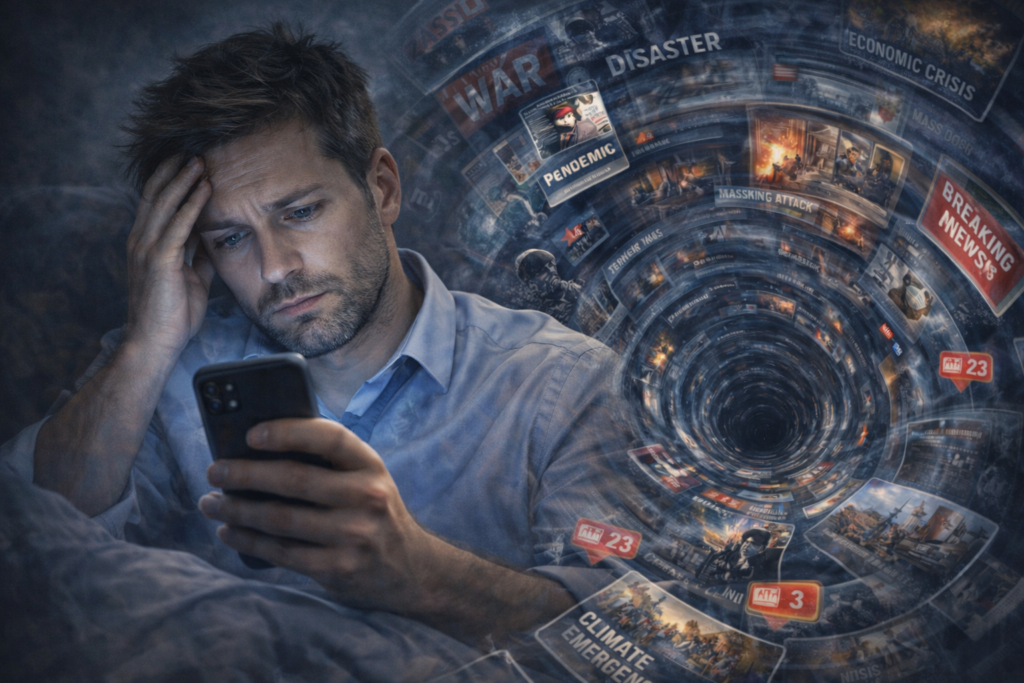
“Your brain thinks it’s gathering safety. But sometimes it’s gathering fear.”
– Wellness Kraft
Introduction
Doomscrolling has a definite vibe: you don’t even enjoy it, but you also can’t stop.
It starts innocently. You check the news. A headline punches you in the face. You scroll for context. Another headline appears. You think, “This is important, I should know.” You scroll again. Now you’re in a tunnel where every turn is another crisis, another warning, another “Experts say…” and your brain keeps whispering: keep going, keep going, keep going.
What makes it feel addictive is that it’s not purely entertainment. It’s survival-flavored.
Bad news triggers something ancient in us. The human brain is wired to prioritize threat because, for most of our history, missing danger had a higher cost than missing good news. If a berry bush is safe, cool. If it’s poisonous, that matters more. Suppose your tribe is fine, friendly. If there’s risk, you need to know.
So your brain treats negative information like: “Pay attention. This could keep you alive.”
The problem is we are not built to consume global threats at high volume, all day, on a device that refreshes forever.
And doomscrolling doesn’t usually end with “Okay, now I’m informed.” It ends with:
- “Now I’m anxious.”
- “Now I’m helpless.”
- “Now I’m angry.”
- “Now I’m numb.”
- “Now I can’t sleep.”
If you’ve ever felt emotionally wrung out after “just checking the news,” you’re not weak. You’re human in a media environment that was designed for maximum attention, not maximum peace.
Here’s a quick interactive check-in before we go deeper:
When you doomscroll, what are you hoping will happen?
Most people say some version of: “I’ll finally feel caught up.”
But the real hope is usually: “I’ll finally feel safe.”
What Doomscrolling Looks Like in Real Life
Doomscrolling isn’t just news. It’s the pattern: distress → scroll → more distress → scroll.
It can show up as:
- checking headlines the moment you wake up
- scrolling disaster updates, crime stories, war footage, market crashes, political chaos
- reading comment sections that feel like emotional acid
- Consuming harmful content even when it clearly worsens your mood
- jumping between apps because one stream isn’t enough to scratch the itch
Many people describe a “stuck” feeling: you want to stop, but stopping feels irresponsible. Like you’ll miss something crucial. Like you’ll be unprepared.
That’s the trap: doomscrolling masquerades as readiness.
Jason’s “Just One More Refresh”
Let’s talk about Jason, 34, working in operations for a healthcare company in Chicago. On paper, he’s doing fine. He pays bills, shows up, and handles life.
But lately, he feels on edge. Not panic attacks, not breakdowns. Just a constant buzzing tension under the surface.
Every morning, Jason reaches for his phone before his feet hit the floor. He tells himself it’s responsible: “I need to know what’s going on.” He opens a news app. Within 90 seconds, he’s reading about layoffs, conflict, crime, a scary disease headline, and a market drop. Then he switches to social media, where the news is louder and more emotional. People are arguing. Somebody’s posting scary clips. Somebody’s predicting collapse.
Jason’s heart rate climbs, but he keeps going because his mind is trying to solve a feeling: uncertainty.
He thinks, “If I read enough, I’ll understand. If I understand, I’ll feel calmer.”
But it doesn’t calm him. It primes him.
By noon, he’s distracted. He checks his phone between tasks. He feels irritable in meetings. His attention keeps snapping back to the world’s problems, even when the meeting is about something simple.
At night, he tries to relax. But his brain feels like a crowded room. So he scrolls again, because scrolling is familiar and oddly soothing in the moment. It’s like scratching an itch, even though it makes the skin worse.
Around 1:00 A,M he puts the phone down and notices the damage:
- mind racing
- chest tight
- doom feeling
- sleep delayed
- next day, it was already ruined
Jason’s not addicted to news because he loves negativity. He’s stuck in a spiral because his brain keeps confusing information with safety.
And the more he scrolls, the more unsafe he feels.
Why Bad News Feels Addictive
Doomscrolling usually runs on a few psychological engines:
1) Negativity bias (your brain’s threat radar)
Your brain naturally gives more attention to negative information because it might matter for survival. That bias isn’t your fault. It’s built-in. But algorithms know it too, and they feed it.
2) “Maybe the next scroll will resolve the tension.”
A lot of doomscrolling is not about learning new facts. It’s about chasing relief. Your brain keeps thinking: the next update might be the one that makes this feel less scary. The following post might bring clarity. The next thread might explain what’s really happening.
But most feeds don’t resolve. They escalate.
3) Intermittent reward (the slot-machine effect)
Most content is disturbing or upsetting, but occasionally you find a reassuring update, a smart explanation, a funny post, or a hopeful story. That unpredictable “sometimes good” pattern can make the habit sticky. Your brain keeps pulling the lever, hoping for relief.
4) Intolerance of uncertainty
Uncertainty is uncomfortable. Doomscrolling can feel like an attempt to reduce that discomfort. But constant exposure to threats often increases uncertainty instead of lowering it.
5) Moral pressure
Some people feel guilty not watching. Like if they look away, they’re uncaring. Doomscrolling becomes a form of emotional duty: “If I suffer with the news, at least I’m paying attention.”
But consuming distress is not the same as helping.
The Doomscrolling Spiral (A Simple Map)
If you want to break the habit, you need to see the structure. Here’s the common spiral:
- You feel anxious, uncertain, lonely, bored, or powerless.
- You check the news or social media to feel informed and in control.
- You encounter alarming content that spikes stress.
- You scroll more to resolve the discomfort.
- You feel worse, more helpless, more tense.
- Your brain learns: “When I feel bad, I scroll.”
- The loop becomes automatic.
The spiral isn’t about a lack of discipline. It’s about emotional regulation using a tool that backfires.
How to Stop Doomscrolling Without Becoming “Uninformed”
Most advice tells you to “just stop.” That fails because it ignores what doomscrolling does to you emotionally.
Instead, we replace doomscrolling with something that gives your brain what it’s actually seeking: clarity, limits, and a sense of agency.
Step 1: Switch from “endless feed” to “bounded briefing”
Create a small news container so your brain stops treating news as a 24/7 emergency.
Try this:
- Pick 2 short windows per day (example: 10 minutes at 9 AM, 10 minutes at 6 PM).
- Outside those windows, no news apps, no crisis reels, no “just checking.”
- If something truly urgent happens, you’ll still hear about it. Real emergencies find you.
This works because it turns news into a choice, not a reflex.
Step 2: Change the question you ask before opening the app
Most people open news apps with the question: “What did I miss?”
Try asking instead: “What do I need to know to live my day well?”
That question is calmer. It reduces the compulsive “I must absorb everything” pressure.
Step 3: Use the “two-click rule”
If the first click is the app, the second click should be your exit.
Example:
- Open app → read top 3 headlines → close.
- Open app → check one trusted source → close.
If you need “more,” write the topic down and come back in your next news window. This prevents the slide into endless scrolling.
Step 4: Replace doom consumption with one action (agency antidote)
The fastest way to reduce helplessness is to do something small and tangible.
Pick one:
- Donate a small amount to a reputable cause
- Volunteer once a month
- Call a representative
- Help a local community project
- support someone directly
- focus on a controllable goal (health, finances, learning, family)
Action turns “I’m drowning in problems” into “I’m part of a solution,” even if it’s small.
Step 5: Make your environment less addictive
If you’re trying to stop doomscrolling but the apps are engineered to pull you back, you need friction.
- remove news apps from the home screen
- Turn off breaking news alerts
- mute keywords on social platforms
- Unfollow accounts that post constant crisis content
- do not read comments when you’re already stressed (comments often inflame anxiety)
Step 6: Use a “body reset” when the urge hits
Doomscrolling is often your nervous system asking for regulation.
Try a 60–90 second reset:
- Inhale through the nose for 4
- exhale slowly for 6
- Repeat 6 times
Then decide: news window or not?
Often, the urge drops once the body calms.
Step 7: If doomscrolling is replacing sleep, treat it as a sleep issue too
Night doomscrolling is especially damaging because it steals recovery and amplifies anxiety. Put a boundary around the last hour before bed:
- no news
- no crisis content
- no comment sections
Replace with something that actually downshifts your nervous system (light reading, stretching, calm audio, warm shower).
Research Insight
Research and clinical guidance describe doomscrolling as persistent attention to negative news in feeds, often tied to stress and poorer well-being. Studies have developed measures of doomscrolling behavior and found associations with mental distress and reduced well-being. At the same time, clinical sources highlight how constant negative news intake can intensify stress, sleep disruption, and anxiety. A useful theme across research is that doomscrolling can be driven by uncertainty and threat sensitivity: the brain keeps seeking information to feel safer, but repeated exposure to harmful content often leaves people feeling worse.
Links (paste as raw URLs in WordPress for auto-clickable sources):
- Harvard Health (2024): https://www.health.harvard.edu/mind-and-mood/doomscrolling-dangers
- APA Monitor (media overload and news-related stress): https://www.apa.org/monitor/2022/11/strain-media-overload
- Peer-reviewed (doomscrolling scale and mental health links): https://pmc.ncbi.nlm.nih.gov/articles/PMC9580444/
- Peer-reviewed (doomscrolling on social media during crises): https://tmb.apaopen.org/pub/nn9uaqsz
- Peer-reviewed (2024 study: doomscrolling and existential anxiety, cross-cultural): https://www.sciencedirect.com/science/article/pii/S245195882400071X
Key Takeaways
- Doomscrolling often feels addictive because your brain mistakes information for safety.
- Harmful content grabs attention fast due to built-in threat sensitivity and algorithm design.
- The spiral is self-feeding: anxiety → scroll → more anxiety → more scrolling.
- You don’t have to quit the news. You need boundaries: short windows, trusted sources, and an exit plan.
- The antidote to helplessness is agency: one small real-world action beats 100 scary headlines.
FAQs
1) Why do I keep scrolling even when it makes me feel worse?
Because the urge isn’t always “I want entertainment.” It’s often “I want certainty.” When anxiety rises, your brain tries to fix it by gathering more information. The catch is that most feeds are designed to keep you in a heightened emotional state, not toward resolution. So you scroll to soothe discomfort, but the content keeps the discomfort alive.
2) Is doomscrolling an actual addiction?
For many people, it behaves like a compulsive habit: it’s hard to stop, it spikes stress, and it can interfere with sleep and focus. Whether you label it an addiction or not, the practical approach is similar: reduce triggers, add friction, and replace the habit with healthier regulation tools.
3) How do I stay informed without spiraling?
Use “bounded briefings.” Two short news windows per day, one or two trusted sources, and a clear stop point. Avoid comment sections and crisis-heavy feeds, especially at night. The goal is informed, not flooded.
4) Why does doomscrolling hit harder at night?
Because at night you’re more tired, your self-control is lower, and anxiety tends to get louder when the world gets quiet. Also, harmful content close to bedtime can keep your nervous system activated, making sleep harder and feeding the cycle the next day.
5) What if I feel guilty for not keeping up with everything?
Caring about the world doesn’t require consuming suffering nonstop. If anything, constant doom intake can make you less effective, more anxious, and more numb. A healthier model is: learn what you need, take one meaningful action when possible, and protect your mind so you can show up as a functioning human.
Concluding Thoughts
Doomscrolling is not a personal failure. It’s a very human response to a very modern problem: unlimited crisis access.
Your brain is trying to do something loving for you: keep you prepared. But preparation has a limit. After that, it becomes poisoning.
So treat news like food:
- choose quality
- choose portions
- don’t binge before bed
- and notice how it makes you feel afterward
If you want a simple rule to try for the next 7 days:
Two news windows a day. No news in the last hour before sleep.
And every time you feel the urge to scroll “just in case,” do one calming breath cycle first.
Because you don’t need more fear.
You need more steadiness.




Join the conversation