
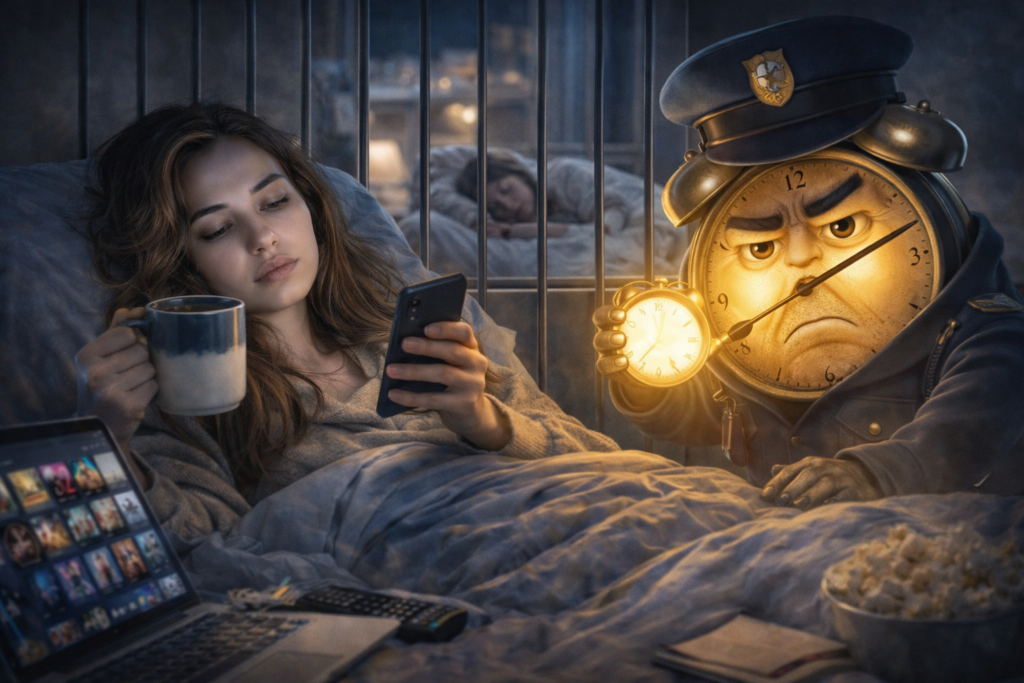
“The problem isn’t that you’re staying up late. It’s what you’re trying to escape when the lights go out.”
– Wellness Kraft
Introduction
Revenge bedtime procrastination sounds dramatic, like you’re plotting something in the dark with a hoodie on. But in real life it’s quieter than that. It’s you, in bed, face lit by a phone, telling yourself: “Just a little longer.”
It’s the weird moment when your body is begging for sleep, but your brain is begging for freedom.
And the reason it’s so common is simple: daytime life has gotten crowded. Work spills into evenings. Parenting eats the clock. Studies stretch past sunset. Everyone wants a piece of you, your attention, your energy, your emotional labor. By the time you finally get silence, you don’t want to waste it on sleep, even if sleep is exactly what you need.
So you steal time.
Not a productive time. Not a noble time.
Soft time. Junk time. Comfort time.
The kind of time where nobody asks anything of you.
And here’s why it becomes a trap: the stolen hours don’t feel like self-care the next morning. They feel like a hangover. You wake up tired, behind, and irritated. Then the day becomes even more stressful, which makes you crave even more “revenge time” at night.
It’s a loop that feeds itself.
If you’ve ever felt guilty at 1:30 AM, thinking “Why am I doing this again?” while still not putting the phone down, you’re not alone. You’re not “weak.” You’re trying to solve a real need (control and recovery) with a tool that quietly makes tomorrow harder.
Let’s unpack it like humans, not like robots.
What Revenge Bedtime Procrastination Actually Feels Like
It’s not just “staying up late.” It has a particular emotional flavor.
1) You feel most alive when everyone else is asleep
There’s a weird peace in late-night hours. No calls. No meetings. No expectations. It’s like the world finally stops leaning on you.
2) You don’t choose sleep, you drift away from it
You don’t make a clear decision to stay awake. You keep going: one more scroll, one more video, one more snack, one more tab.
3) The content isn’t even that enjoyable
This is the part people don’t admit. A lot of the time, the entertainment isn’t amazing. It’s just easy. It’s low-effort. It doesn’t ask you to be brave, focused, or emotionally present.
4) You feel both comfort and guilt at the same time
Comfort: “Finally, my time.”
Guilt: “I’m ruining tomorrow.”
Then your brain tries to escape guilt by consuming more comfort. That’s how the night disappears.
5) You feel resentful of sleep
Not consciously, but subtly. Sleep feels like something you “should” do, like a chore. And when you’ve spent the whole day doing chores for life, you don’t want another one.
Emily’s Midnight “Freedom Hour”
Let’s talk about Emily, 29, a marketing coordinator in Denver. She’s clever, funny, and organized. She’s not falling apart in public. Her boss likes her. Her friends think she’s doing fine.
Her day starts at 7:30 AM. She’s instantly “on.” Emails. Slack messages. Client edits. Campaign tracking. A meeting that could’ve been an email. She squeezes lunch into 12 minutes while staring at a screen. After work, she tries to be a real person: workout, groceries, laundry, call her mom, reply to friends.
By 9:30 PM, she’s done. Not “done with tasks.” Done as a human battery.
Emily promises herself: “Tonight I’m sleeping early.”
Then bedtime arrives, and her brain goes:
“No.”
Not loudly. Not dramatically. Just: no.
Because sleep means the next day begins sooner. Sleep means she loses the only time she gets to exist without producing. Sleep means she’s back in the machine again.
So she opens TikTok “for 10 minutes.”
Ten becomes forty.
Then she checks Instagram.
Then she watches a YouTube video.
Then she starts a show because she needs something to quiet her thoughts.
At 12:45 AM, she’s not even enjoying it. She’s numb-scrolling. She’s half watching. Her eyes are dry. Her mind is buzzing. But the idea of putting the phone down feels weirdly sad, like closing a door on herself.
At 1:10 AM she finally sleeps.
The next morning, she wakes up tired, foggy, and irritated. Her coffee hits, her adrenaline kicks in, and she “functions.” By afternoon,n she’s drained again. Everything feels heavier. She gets less done. She stays late to catch up. She gets home later.
Now bedtime feels even more precious.
So she steals time again.
Emily didn’t develop this habit because she loves being exhausted. She created it because her brain is trying to reclaim something important: autonomy, leisure, and emotional decompression.
The problem is the method.
Her “freedom hour” is real, but it’s coming with interest.
Why This Happens (The Real Root, Not the Pinterest Version)
Revenge bedtime procrastination usually comes from a mix of these:
1) Lack of control in the daytime
If your day is primarily obligations, your night becomes rebellion. It’s your only proof that you’re not just a worker, a caregiver, a student, or a role.
2) You’re not actually resting during the day
Even breaks are contaminated. You eat while scrolling. You “relax” while thinking about tomorrow. Your nervous system never fully powers down.
So at night, you chase the feeling of a proper break.
3) You’re avoiding your own thoughts
When the lights go out, the mind gets loud—regrets, worries, future planning, old conversations. The phone becomes a pacifier, not entertainment.
4) You’re trying to make life feel fair
This sounds strange, but it’s real. If your day felt unfair, your brain tries to correct it at night: “I deserve something.” And you do deserve something. But sleep is also something you deserve.
5) Decision fatigue and depleted self-control
After a long day of saying “yes,” deciding, solving, and holding it together, your ability to choose the hard-but-good option (sleep) gets weaker. The easy option (scroll) wins.
The “Nighttime Rebellion Loop” (Why It Keeps Repeating)
Here’s the loop in plain language:
- Your day feels controlled by obligations.
- You feel emotionally deprived of free time.
- At night, you reclaim freedom by staying up.
- You sleep less, so tomorrow is harder.
- A harder tomorrow increases stress and reduces control.
- You crave revenge time again.
It’s not a moral failure. It’s a predictable cycle.
The fix isn’t “be disciplined.” The fix is to break the loop in a way that still respects the underlying need.
How to Stop Revenge Bedtime Procrastination Without Feeling Like Life Got Worse
The biggest mistake people make is trying to quit “night freedom” cold turkey. That feels like punishment, and punishment tends to backfire.
Instead, we do a more brilliant move: keep the freedom, but move it earlier and make it intentional.
Step 1: Give yourself a real “daily freedom deposit”
If you don’t get any personal time in the day, you’ll take it at night.
Pick a tiny, protected window earlier:
- 15 minutes after work, phone-free, doing something you actually like
- a walk with music
- stretching and showering like a ritual, not a rush
- journaling one page
- calling a friend for an honest conversation
- cooking something simple while listening to something soothing
Think of it like this: if your brain gets even a small taste of “my life belongs to me,” it’s less likely to panic-grab hours at midnight.
Step 2: Create a “closing ceremony” for the day
Most people go from work mode to bed with no transition. Your brain doesn’t understand that work ended.
Try a 10-minute closing ritual:
- write tomorrow’s top 3 tasks (so your brain stops holding them)
- lay out clothes or prep one small thing
- tidy the space for 3 minutes
- wash your face slowly
- dim lights
- phone goes on charge away from the bed
The goal is to signal: “The day is finished.”
Step 3: Keep your revenge time, but put it on a schedule
This sounds too simple, but it works because it removes the feeling of deprivation.
Example:
- “I get 30 minutes of guilt-free fun from 10:00 to 10:30.”
Then the bedtime routine begins.
If you try to remove fun entirely, your brain fights you. If you give it a planned slice, your brain relaxes.
Step 4: Use the “Two Alarms” trick
One alarm for bedtime is often ignored. Two alarms work better because the first isn’t the final decision.
- Alarm 1: “Start winding down.”
- Alarm 2 (30–45 min later): “Lights out.”
This turns bedtime into a ramp, not a cliff.
Step 5: Swap passive scrolling for “real recovery”
Here’s the harsh truth: a lot of late-night content is not recovery, it’s sedation.
Try replacing the last 20 minutes with something that actually lowers stress:
- warm shower
- gentle stretching
- reading something light
- breathing longer exhales (inhale 4, exhale 6, repeat 6 times)
- calming audio (not doom content)
You’re not banning entertainment. You’re upgrading the last mile.
Step 6: If you can’t stop scrolling, change the environment
Self-control is easier when the environment supports it.
- Charge the phone outside the bedroom
- Use a real alarm clock
- Keep a book near the bed
- Use “downtime” settings to lock apps after a particular hour
- Remove the most addictive apps from the home screen
Make the easy path point toward sleep.
Step 7: Address the real emotion underneath
Sometimes, revenge bedtime procrastination is a signal of deeper issues:
- chronic burnout
- anxiety that spikes at night
- loneliness
- depression
- relationship stress
- a life that feels like obligations with no joy
If your nights are the only time you feel like yourself, that’s not just a sleep habit. That’s a life design problem. And it deserves compassion and support.
Research Insight
Revenge bedtime procrastination is commonly described as intentionally delaying sleep to reclaim personal time, often when daytime life feels controlled or exhausting. It overlaps with the broader concept of bedtime procrastination, which research links with self-regulation, routines, and sleep outcomes.
In simple terms, the research-based picture looks like this:
- People delay bedtime even when they know it will hurt them the next day, often because the night feels like their only free, self-directed time.
- Bedtime procrastination is associated with reduced sleep time and fatigue, and studies discuss the role of self-control, habits, and planning.
- Sleep and health organizations recommend consistent routines, reducing screens near bedtime, and building wind-down cues that help the brain shift into sleep mode.
Links (paste as raw URLs in WordPress for auto-clickable sources):
- Sleep Foundation (definition and guidance): https://www.sleepfoundation.org/sleep-hygiene/revenge-bedtime-procrastination
- Cleveland Clinic (practical tips to stop): https://health.clevelandclinic.org/revenge-bedtime-procrastination
- Stanford Student Affairs (student-friendly explanation + why it happens): https://studentaffairs.stanford.edu/sleep-revenge-bedtime-procrastination
- Peer-reviewed daily diary study on bedtime procrastination factors: https://pmc.ncbi.nlm.nih.gov/articles/PMC6759770/
Key Takeaways
- Revenge bedtime procrastination is often a response to feeling like your day isn’t yours.
- The need underneath it is real: autonomy, decompression, and emotional relief.
- The loop is self-reinforcing: less sleep makes tomorrow harder, which makes you crave more night freedom.
- The goal isn’t “no fun at night,” it’s “intentional fun + a sleep ramp.”
- Small changes like a wind-down alarm, phone placement, and a daily freedom deposit can break the cycle.
FAQs
1) Why do I only want “me time” at night?
Because night is the first time you’re not being watched, needed, or judged, if your day is packed with demands, your brain starts treating nighttime as your only private territory. It’s not that you suddenly become undisciplined at 11 PM. It’s that your brain finally senses space and doesn’t want to give it up.
2) Is this just procrastination, or is something wrong with me?
Most of the time, it’s not “something wrong.” It’s a coping strategy that got too strong. You’re meeting a real need (control and recovery) with a method that costs you sleep. If the pattern is severe, persistent, or tied to anxiety, depression, or burnout symptoms, it may be worth talking to a professional. Not because you’re broken, but because you deserve support.
3) Why do I keep scrolling even when I’m not enjoying it?
Because at that point it’s not entertainment, it’s regulation. Scrolling can numb stress and distract you from thoughts you don’t want to face. It also provides constant novelty, keeping the brain stimulated and delaying the moment when you have to sit alone in silence.
4) What’s the fastest change that actually works?
For most people: a two-alarm wind-down system + moving the phone away from the bed. The first alarm signals “start closing the day.” The second alarm is the final cue for lights out. If the phone is within arm’s reach, your brain will negotiate. If it’s across the room, your body has a chance to settle.
5) What if bedtime is the only time I feel in control?
Then don’t take control away. Move it. Create a small “daily freedom deposit” earlier, even 15 minutes, that belongs to you. If your day contains some absolute autonomy, your brain won’t fight bedtime as hard. If your life genuinely leaves you no space at all, that’s a bigger issue than sleep. It’s a signal your schedule needs boundaries, support, or redesign.
Concluding Thoughts
Revenge bedtime procrastination isn’t you being immature. It’s you trying to reclaim your life in the only hours that feel like yours.
But sleep is not the enemy. Sleep is the foundation that makes tomorrow less cruel.
So instead of waging war on your nights, try something kinder and wiser:
- Give yourself a small slice of freedom earlier,
- plan a guilt-free fun window,
- build a wind-down ramp,
- and protect sleep like it’s your future self’s paycheck.
Because it is.




Join the conversation