
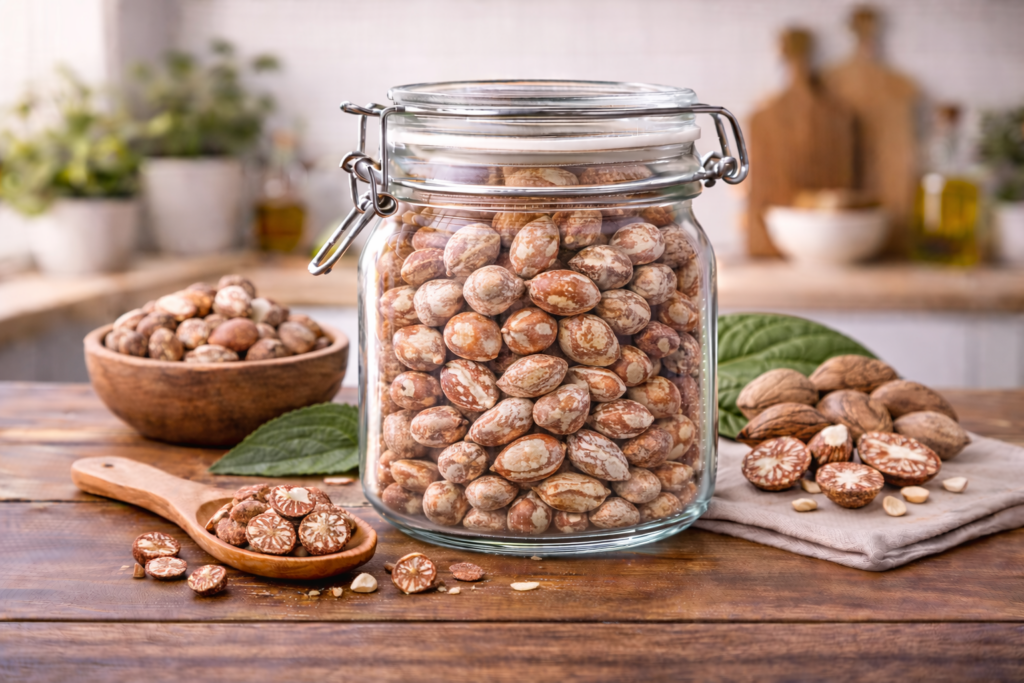
Areca nut is often used in chewing preparations rather than as a food snack. From a wellness point of view, it is not a recommended “healthy nut.”
In a nutshell: The values provided are approximate and can vary depending on the size and ripeness.
1) Areca nut
Nutritional facts per 100g
| Nutrient | Amount Per 100g | % Daily Value* |
|---|---|---|
| Calories | 342 kcal | 17% |
| Carbohydrates | 56.7 g | 21% |
| Fiber | — | — |
| Sugars | — | – |
| Protein | 5.2 g | 10% |
| Fat | 10.2 g | 13% |
| Vitamin A | — | — |
| Vitamin C | — | — |
| Potassium | 450 mg | 10% |
| Calcium | 400 mg | 40% |
Pros
- Historically used in cultural chewing practices.
- Contains minerals like calcium in some forms.
- Not a sugary food by default.
Cons
- Regular chewing is strongly linked with oral health harms and is not recommended as a wellness habit.
- Can be addictive due to stimulant-like effects.
- Not a typical edible snack nut like almonds or walnuts.
Right time to eat
- Not recommended as a daily food choice.
- If used culturally, keep use minimal and occasional.
Health benefits
- From a nutrition perspective, there are better and safer nut choices.
- Choose almonds, walnuts, pistachios, or peanuts for practical health goals.
- Use this mainly as an informational entry.
Best way to eat
- If you are choosing a “nut for health,” pick safer edible nuts instead.
- Avoid sweetened chewing mixes.
- Prioritise oral health and safety.
*Percent Daily Values are based on a 2,000 calorie diet.


Join the conversation