
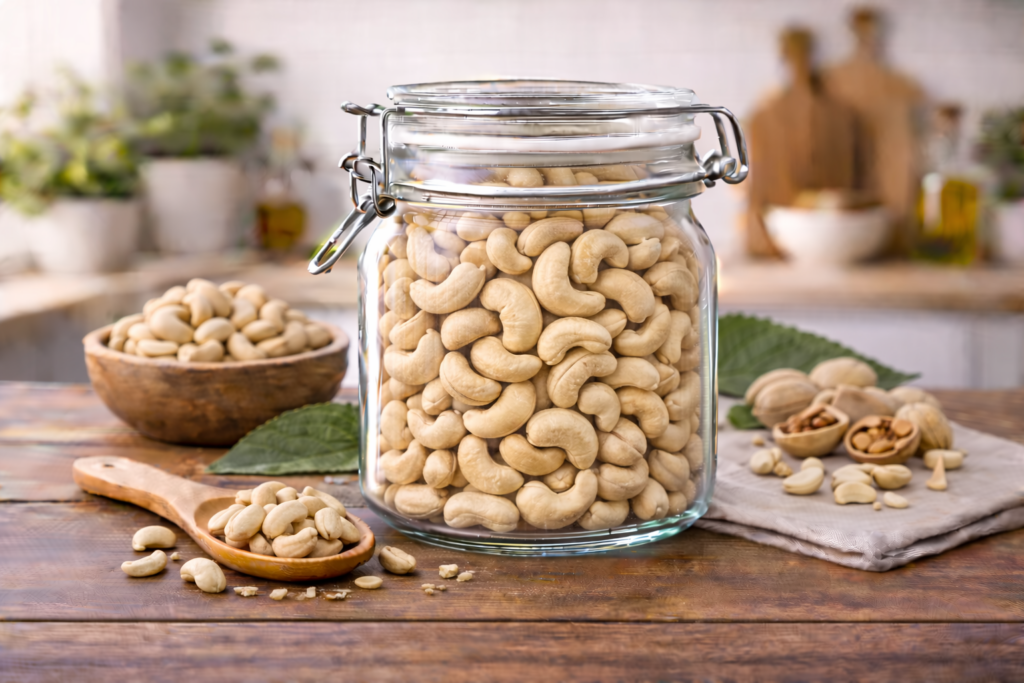
Cashews taste buttery and mild, which is why they disappear fast. They are nourishing, but they reward controlled portions.
In a nutshell: The values provided are approximate and can vary depending on the brand, processing, and freshness.
1) Cashew
Nutritional facts per 100g
| Nutrient | Amount Per 100g | % Daily Value* |
|---|---|---|
| Calories | 553 kcal | 28% |
| Carbohydrates | 30.2 g | 11% |
| Fiber | 3.3 g | 12% |
| Sugars | 5.9 g | – |
| Protein | 18.2 g | 36% |
| Fat | 43.9 g | 56% |
| Vitamin A | 0 IU | 0% |
| Vitamin C | 0.5 mg | 1% |
| Potassium | 660 mg | 14% |
| Calcium | 37 mg | 3% |
Pros
- Comforting, filling snack that pairs well with fruit.
- Good for calorie-controlled snacking when portioned.
- Easy to use in gravies, smoothies, and homemade bars.
Cons
- Easy to overeat because of the taste and soft texture.
- Salted cashews can increase sodium intake quickly.
- Not suitable for people with nut allergy.
Right time to eat
- Evening snack when cravings hit.
- With breakfast as a measured topping.
- Avoid large portions late-night if heavy foods affect sleep.
Health benefits
- Helps keep snacks more satisfying than biscuits or fried snacks.
- Supports steady energy because it is fat + protein rich.
- Potassium supports normal daily electrolyte balance.
Best way to eat
- Choose unsalted or lightly salted roasted cashews.
- Use in cooking for creaminess instead of heavy cream sometimes.
- Pre-portion into small containers to avoid overeating.
*Percent Daily Values are based on a 2,000 calorie diet.


Join the conversation