
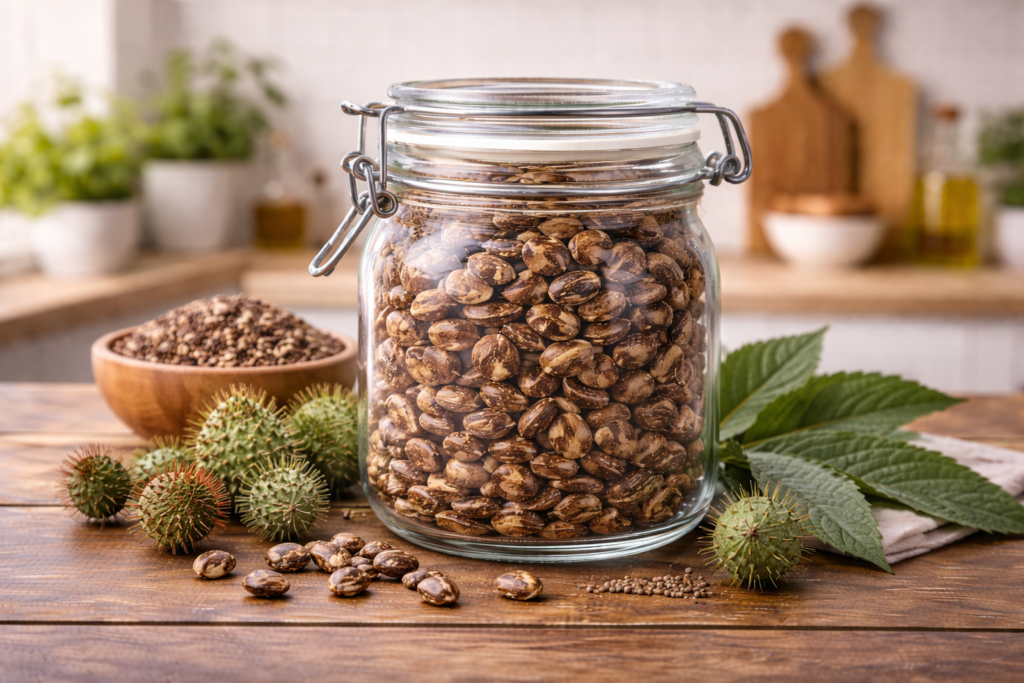
Castor seed exists on oilseed lists, but it is not a food seed. It is unsafe to eat and should never be used as a snack or home remedy.
In a nutshell: Castor seeds are not edible. This entry is included for awareness and safety.
1) Castor seed (not edible)
Nutritional facts per 100g
| Nutrient | Amount Per 100g | % Daily Value* |
|---|---|---|
| Calories | — | — |
| Carbohydrates | — | — |
| Fiber | — | — |
| Sugars | — | – |
| Protein | — | — |
| Fat | — | — |
| Vitamin A | — | — |
| Vitamin C | — | — |
| Potassium | — | — |
| Calcium | — | — |
Pros
- Useful industrial oilseed (non-food context).
- Important to know about for safety awareness.
- Helps prevent accidental misuse.
Cons
- Unsafe to consume.
- Not a food seed.
- Do not taste or experiment.
Right time to eat
- Not applicable. Do not consume.
Health benefits
- No food-related benefit because it is not edible.
- Choose safe edible seeds instead (sesame, flax, pumpkin, sunflower).
- If you have constipation or gut issues, use food-based options rather than risky seeds.
Best way to eat
- Do not eat castor seeds.
- Keep away from children and pets.
- Use only food-safe seeds for nutrition.
*Percent Daily Values are based on a 2,000 calorie diet.


Join the conversation