
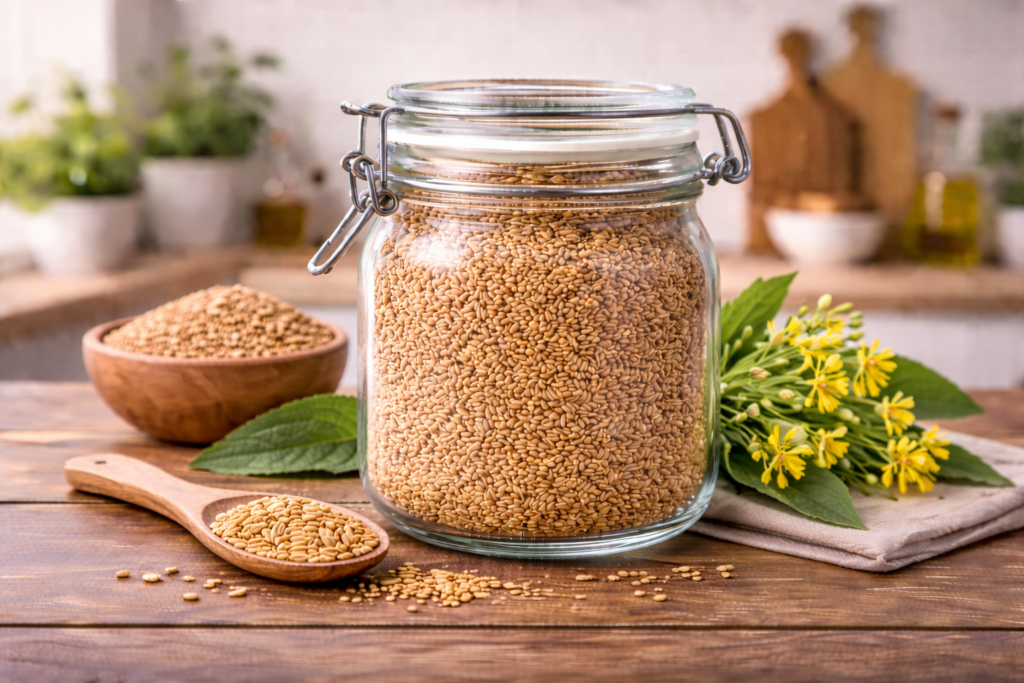
Mustard seeds are tiny, sharp, and flavour-packed. You rarely eat them in big quantities, but they quietly upgrade food and make simple dishes taste complete.
In a nutshell: The values provided are approximate and can vary depending on the variety and processing.
1) Mustard (sarson/rai)
Nutritional facts per 100g
| Nutrient | Amount Per 100g | % Daily Value* |
|---|---|---|
| Calories | 508 kcal | 25% |
| Carbohydrates | 28.1 g | 10% |
| Fiber | 12.2 g | 44% |
| Sugars | 6.8 g | – |
| Protein | 26.1 g | 52% |
| Fat | 36.2 g | 46% |
| Vitamin A | 31 IU | 1% |
| Vitamin C | 7.1 mg | 12% |
| Potassium | 828 mg | 18% |
| Calcium | 266 mg | 20% |
Pros
- Big flavour in small quantity, helps reduce need for heavy sauces.
- Useful in tempering, pickles, chutneys, and mustard paste.
- Can make simple meals feel more satisfying.
Cons
- Strong and spicy for some people, can trigger acidity if you overdo it.
- Pickles/mustard sauces may add a lot of salt.
- Not eaten in large amounts usually.
Right time to eat
- With meals as tempering or paste.
- Best earlier in the day if spicy foods affect you at night.
Health benefits
- Helps make home-cooked meals tasty without ultra-processed flavours.
- Supports satisfaction when used in balanced meals.
- Encourages better adherence to home food routines.
Best way to eat
- Use in tempering (tadka) or grind for mustard paste.
- Keep pickle portions small because salt can be high.
- Store dry and airtight.
*Percent Daily Values are based on a 2,000 calorie diet.


Join the conversation