
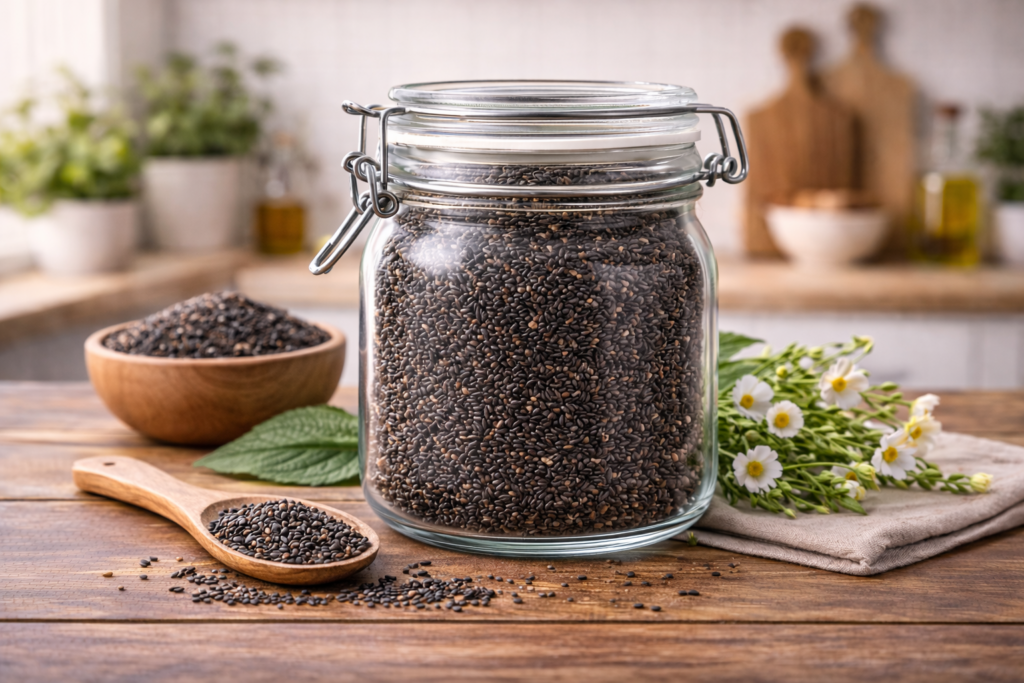
Niger seed (ramtil) is mostly valued for oil and traditional uses. If you eat it, the key is one thing: make sure it’s food-grade, not bird-feed quality.
In a nutshell: The values provided are approximate and can vary depending on the source and processing.
1) Niger seed (ramtil)
Nutritional facts per 100g
| Nutrient | Amount Per 100g | % Daily Value* |
|---|---|---|
| Calories | 515 kcal | 26% |
| Carbohydrates | 32 g | 12% |
| Fiber | 14 g | 50% |
| Sugars | 2 g | – |
| Protein | 18 g | 36% |
| Fat | 37 g | 47% |
| Vitamin A | 0 IU | 0% |
| Vitamin C | 0 mg | 0% |
| Potassium | 450 mg | 10% |
| Calcium | 200 mg | 15% |
Pros
- Can be used in traditional chutney/powder mixes in small amounts.
- Fats + protein can support fullness.
- Oil use is common in some cuisines.
Cons
- Quality matters a lot, avoid non-food-grade seed.
- Calorie-dense, portion control is important.
- Not as widely available as common edible seeds.
Right time to eat
- With meals as part of chutney/powder.
- Not ideal as a late-night heavy snack.
Health benefits
- Supports meal satisfaction when used in small amounts.
- Helps reduce dependence on processed flavour boosters.
- Can support satiety when used wisely.
Best way to eat
- Use only food-grade niger seed.
- Roast lightly and grind into chutney/powder.
- Keep portion small because it is energy-dense.
*Percent Daily Values are based on a 2,000 calorie diet.


Join the conversation