
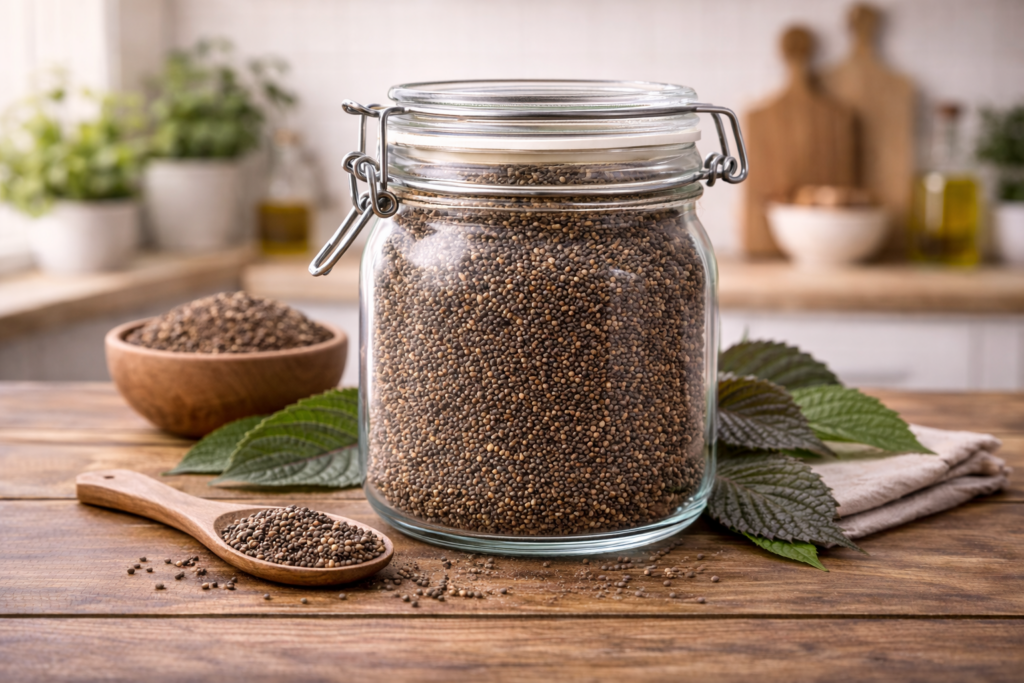
Perilla seeds are nutty and rich, often used roasted or powdered in Asian-style cooking. They’re best used as a “small add-on” that upgrades meals.
In a nutshell: The values provided are approximate and can vary depending on variety and processing.
1) Perilla seeds
Nutritional facts per 100g
| Nutrient | Amount Per 100g | % Daily Value* |
|---|---|---|
| Calories | 544 kcal | 27% |
| Carbohydrates | 28 g | 10% |
| Fiber | 20 g | 71% |
| Sugars | 1.5 g | – |
| Protein | 18 g | 36% |
| Fat | 42 g | 54% |
| Vitamin A | 0 IU | 0% |
| Vitamin C | 0 mg | 0% |
| Potassium | 700 mg | 15% |
| Calcium | 200 mg | 15% |
Pros
- Rich, satisfying seed that helps meals feel complete.
- Works well roasted and ground into sauces/powders.
- Good add-on for people bored of the same seeds daily.
Cons
- Calorie-dense, portion control matters.
- Not easily available everywhere, quality varies.
- Can feel heavy if you eat large amounts at night.
Right time to eat
- With meals as a roasted topping or paste.
- Earlier in the day if rich foods feel heavy at night.
Health benefits
- Supports satiety and steadier energy when used in small amounts.
- Helps reduce processed snack cravings by making meals more satisfying.
- Useful variety option for seed rotations.
Best way to eat
- Lightly roast and use as topping or grind into paste.
- Keep portions small because it is energy-dense.
- Buy food-grade seeds only.
*Percent Daily Values are based on a 2,000 calorie diet.


Join the conversation