
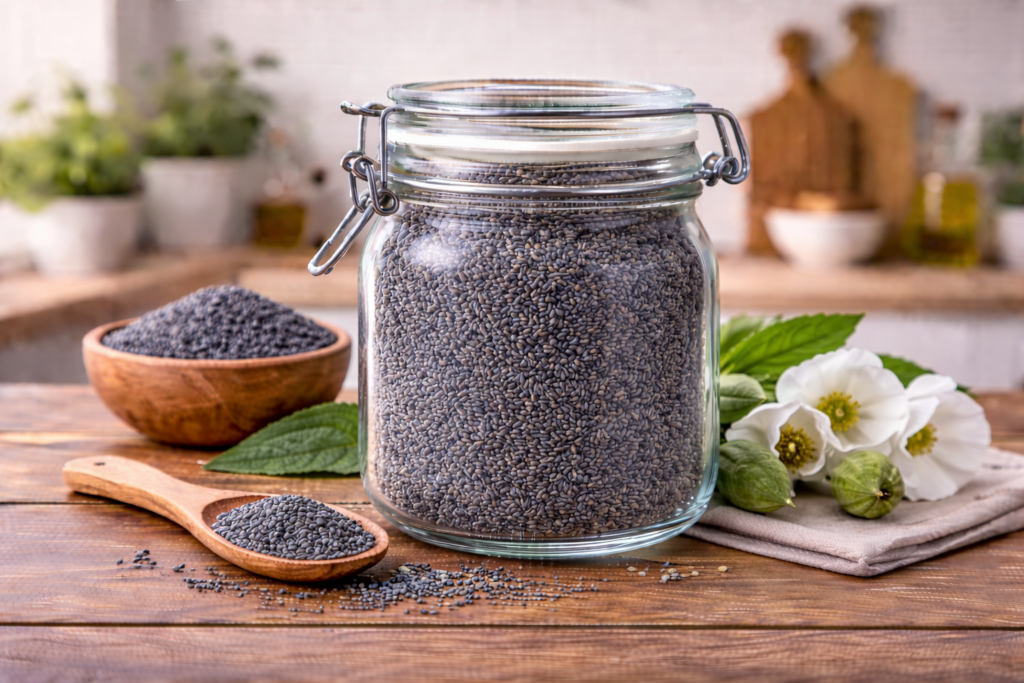
Poppy seeds are tiny, but they are rich and dense. They are best used as an ingredient in small quantities, not as a standalone snack.
In a nutshell: The values provided are approximate and can vary depending on the variety and processing.
1) Poppy seeds khus khus
Nutritional facts per 100g
| Nutrient | Amount Per 100g | % Daily Value* |
|---|---|---|
| Calories | 525 kcal | 26% |
| Carbohydrates | 28.1 g | 10% |
| Fiber | 19.5 g | 70% |
| Sugars | 3.0 g | – |
| Protein | 18.0 g | 36% |
| Fat | 41.6 g | 53% |
| Vitamin A | 0 IU | 0% |
| Vitamin C | 1 mg | 2% |
| Potassium | 719 mg | 15% |
| Calcium | 1438 mg | 111% |
Pros
- Very small quantity adds richness to gravies and desserts.
- Fiber supports meal fullness when used sensibly.
- Good ingredient choice for homemade recipes over packaged mixes.
Cons
- Calorie-dense if you use large amounts frequently.
- Not a practical daily snack food in big quantities.
- Quality varies a lot, store properly to avoid stale taste.
Right time to eat
- With meals as a cooked ingredient.
- Earlier in the day if you find rich foods heavy at night.
Health benefits
- Supports satiety when used in cooking in small amounts.
- Helps make home meals more satisfying without ultra-processed add-ons.
- Fiber supports digestion routines when portioned.
Best way to eat
- Soak and grind for gravies and fillings.
- Use measured amounts, not large servings.
- Store airtight in a cool place.
*Percent Daily Values are based on a 2,000 calorie diet.


Join the conversation