
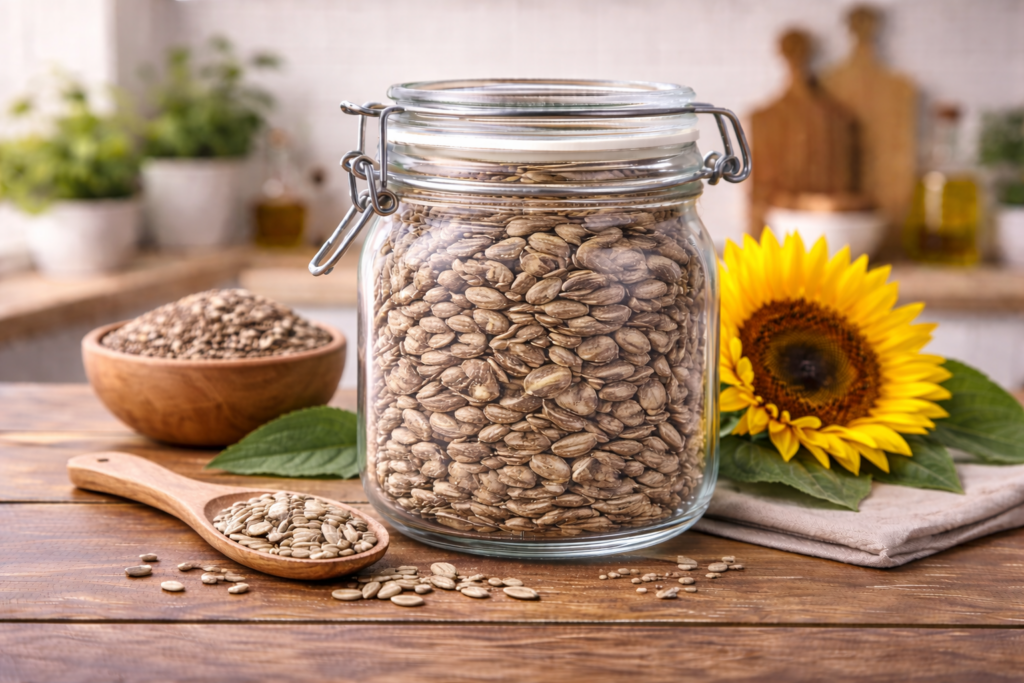
Sunflower seeds are small but powerful. They add crunch to meals, make snacks more filling, and taste great even with minimal seasoning.
In a nutshell: The values provided are approximate and can vary depending on the variety, roasting, and processing.
1) Sunflower seeds
Nutritional facts per 100g
| Nutrient | Amount Per 100g | % Daily Value* |
|---|---|---|
| Calories | 584 kcal | 29% |
| Carbohydrates | 20 g | 7% |
| Fiber | 8.6 g | 31% |
| Sugars | 2.6 g | – |
| Protein | 20.8 g | 42% |
| Fat | 51.5 g | 66% |
| Vitamin A | 50 IU | 1% |
| Vitamin C | 1.4 mg | 2% |
| Potassium | 645 mg | 14% |
| Calcium | 78 mg | 6% |
Pros
- Crunchy and filling, helps reduce random snacking.
- Easy to add to salads, oats, curd bowls, and smoothies.
- Works well as a portable snack in measured portions.
Cons
- Salted versions can push sodium high quickly.
- Calorie-dense, mindless eating is easy.
- Can feel heavy on digestion if eaten in large amounts.
Right time to eat
- Mid-morning snack in a small portion.
- Evening snack to replace chips and namkeen.
- With meals as topping for better fullness.
Health benefits
- Supports satiety and steadier energy between meals.
- Helps reduce cravings for ultra-processed crunchy snacks.
- Fiber supports digestion routines when portioned.
Best way to eat
- Prefer dry-roasted, unsalted or lightly salted.
- Pre-portion into a small snack box.
- Use as topping instead of eating large handfuls.
*Percent Daily Values are based on a 2,000 calorie diet.


Join the conversation