
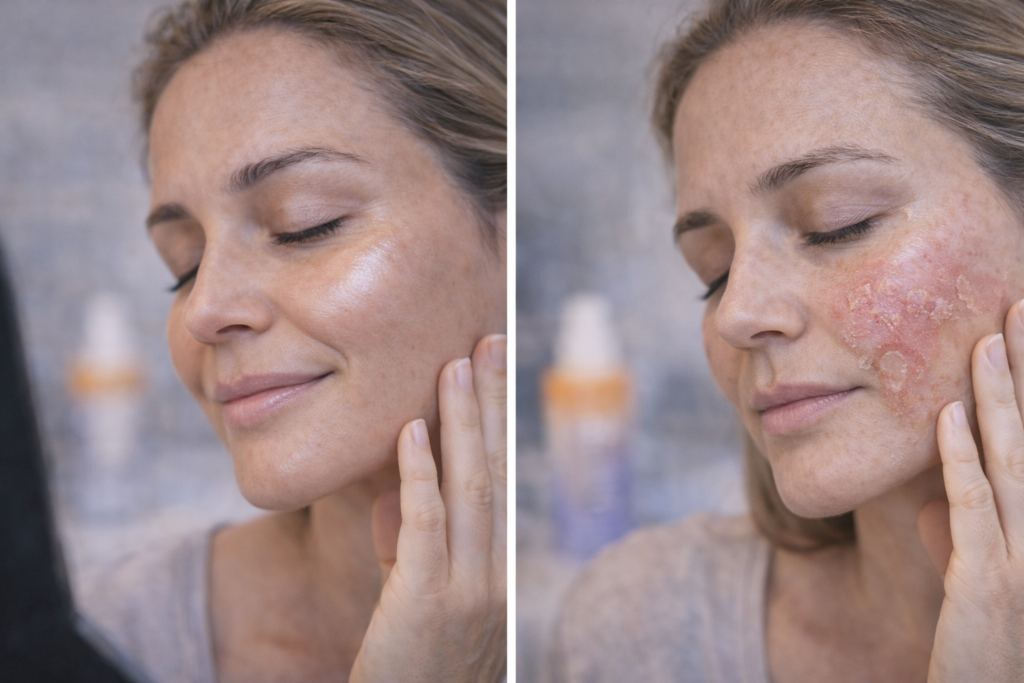
“Glow that burns is not glow. It’s a warning light.” – Wellness Kraft
Introduction
Let’s talk about the modern skincare vibe: everyone has a routine, everyone has actives, and everyone’s skin is “in progress.”
And that’s fine. But the real issue is the pace.
Your skin barrier is not a trophy you win. It’s a living protective layer that gets tired. When it’s healthy, your face feels calm, your products sit well, and your skin is resilient. When it’s damaged, everything becomes dramatic: water stings, moisturizer burns, your face gets red for no reason, and even “gentle” products feel spicy.
Most people don’t cross the line into over-exfoliation in one day. They cross it slowly while thinking they’re being disciplined.
They add one acid.
Then another.
Then a scrub “for extra smoothness.”
Then a retinoid “because everyone says you need it.”
Then they add vitamin C.
Then they add niacinamide.
Then they add a clay mask.
And the barrier just quietly starts losing.
Skin cycling became popular because it’s basically a structured way to stop that.
Not by banning actives.
By scheduling recovery.
What “Skin Cycling” Actually Means (Simple, Real Version)
Skin cycling is a routine where you don’t hit your skin with strong actives every night. You rotate “active nights” and “recovery nights.”
The classic skin cycling pattern looks like this:
Night 1: Exfoliation (AHA or BHA)
Night 2: Retinoid (retinol, tretinoin, adapalene etc.)
Night 3: Recovery (hydrate and repair)
Night 4: Recovery (hydrate and repair)
Then repeat.
But here’s the truth: skin cycling is not a fixed calendar. It’s a concept. The schedule should match your skin’s tolerance.
If you have sensitive skin, you might need 3 recovery nights.
If you have tough, oily skin, you might handle fewer recovery nights.
If you’re new to actives, your cycle should start gentler and slower.
The point is not perfection. The point is keeping your barrier calm while still getting results.
Over-Exfoliation Symptoms (The “Glow Trap” Stages)
People expect over-exfoliation to look obvious. Like peeling sheets of skin or a bright red face. Sometimes yes, but often the earliest signs are subtle and easy to ignore.
Stage 1: The “This is working!” stage
Skin feels extra smooth.
Skin looks slightly brighter.
Makeup sits more evenly.
You get that polished look.
This is where people get addicted. Because it feels like proof.
Stage 2: The “Why is my skin acting weird?” stage
Skin feels tight after cleansing.
You get mild redness more often.
You notice small bumps that don’t behave like your normal acne.
Your skin becomes shinier in a strange way, not a healthy glow.
You start feeling mild stinging with products that used to feel fine.
This is the danger stage because people usually respond by adding more actives or buying stronger products.
Stage 3: The “Barrier alarm” stage
Moisturizer stings or burns.
Your skin feels raw after washing.
Redness sticks around, not just for a few minutes.
Your face becomes reactive to sweat, wind, sunlight, or hot water.
You may peel around the nose, mouth, or eyes.
You can get breakouts because inflamed skin behaves unpredictably.
At this stage, pushing through makes it worse. The skin needs recovery, not more work.
Damaged Skin Barrier Signs (How It Feels Day-to-Day)
A damaged barrier is not just “dry skin.” It’s skin that can’t protect itself well.
Common signs:
- Stinging with basic products (especially moisturizer or cleanser)
- Burning with water or after showering
- Redness that appears easily and lingers
- Tightness even after moisturizer
- Flaky patches that keep returning
- Sudden sensitivity to weather or sweat
- Breakouts or bumps from irritation, not just clogged pores
The biggest clue is this:
If your skin starts reacting to products that never bothered you before, the barrier is usually struggling.
Why Glycolic Acid Irritation Happens So Easily
Glycolic acid is an AHA with a small molecule size, which means it can penetrate efficiently. That’s part of why it works well for texture and brightness. It’s also why it can irritate quickly, especially when:
- You use it too frequently (daily when your skin can’t tolerate daily)
- The concentration is high
- The pH is strong (more “active” at lower pH)
- Your barrier is already compromised
- You combine it with other exfoliants or retinoids
- You scrub physically on top of it
Many people don’t realize they’re exfoliating multiple times. For example:
Acid cleanser + glycolic toner + “brightening” serum (that secretly has acids) = repeated exfoliation.
The irritation is not because glycolic is “bad.”
It’s because your routine became too heavy.
How Often Should You Exfoliate (Realistic Answer)
This depends on:
Your skin type, your barrier strength, and what you’re using.
But the most useful answer is based on tolerance, not ambition.
For beginners or sensitive skin
Once a week is often plenty.
For normal to combination skin
1–2 times a week is often enough.
For oily, resilient skin
2–3 times a week may be tolerated, sometimes more, but “more” only makes sense if the skin stays calm.
Daily exfoliation is where many people fall into over-exfoliation, especially if they’re also using retinoids.
A simple rule:
If your skin stings, you’ve crossed the line. If it’s calm, you can consider slowly increasing.
Retinol and Acids Rotation (The Smart Way)
Retinoids and acids are both powerful. Using them together on the same night can be too much for many people, especially if you’re new or sensitive.
The safest approach for most people
Acid night and retinoid night should be on different days.
Recovery nights should be true recovery.
Example schedule:
Night 1: Exfoliant (AHA or BHA)
Night 2: Recovery
Night 3: Retinoid
Night 4: Recovery
Night 5: Recovery
Then repeat.
This is slower than the “popular” cycle, but it’s more sustainable for a lot of real people.
If you’re experienced and tolerant
You might do:
Night 1: Exfoliant
Night 2: Retinoid
Night 3: Recovery
Night 4: Retinoid
Night 5: Recovery
But again, tolerance decides. Not trends.
“The Routine That Worked Until It Didn’t”
Ashley is 27. She starts skincare with one goal: smooth texture and fewer breakouts. She begins with a glycolic toner twice a week and sees good results. She feels confident.
Then she adds a salicylic acid cleanser because she wants fewer blackheads.
Then she adds a retinol because she sees everyone praising it.
Then she adds a scrub “just once a week.”
Then she adds a clay mask because she’s oily.
At first, her skin looks extra bright. She thinks she found the formula.
Then the stinging starts. Moisturizer burns. Her cheeks flush randomly. She starts peeling around the mouth. She’s confused because she’s using “good products.”
But the issue isn’t the products. It’s the stacking.
Ashley didn’t need a new moisturizer. She needed a recovery plan.
She stops all actives for two weeks. Gentle cleanser, moisturizer, sunscreen. Her skin calms down. Then she restarts slowly, but this time she rotates: acid once a week, retinoid twice a week, recovery the rest.
Within a month, her skin looks better than it did during the “glow trap” phase, and it feels comfortable again.
That’s the difference between glow and inflammation: inflammation is loud. Glow is calm.
How to Fix Over-Exfoliation (Step-by-Step, No Shortcuts)
If your skin is stinging, peeling, red, or reactive, here’s the practical approach.
Step 1: Stop all actives immediately
Pause:
AHA/BHA (glycolic, lactic, salicylic)
Retinoids (retinol, tretinoin, adapalene)
Vitamin C (if it stings)
Benzoyl peroxide (can be irritating)
Scrubs, cleansing brushes, peeling gels
Clay masks and harsh foaming cleansers
This is not “giving up.” It’s recovery.
Step 2: Go boring for 7–14 days
Morning:
Gentle cleanse (or just water if cleansing stings)
Moisturizer
Sunscreen
Night:
Gentle cleanse
Moisturizer
Optional occlusive barrier balm if you’re very dry (only if it doesn’t break you out)
The goal is zero sting.
Step 3: Repair the barrier with the right texture
Look for moisturizers that support the barrier:
Ceramides, glycerin, fatty acids, petrolatum-based options if needed.
Avoid:
Strong fragrance, lots of essential oils, and “tingly” actives.
Step 4: Reintroduce one active slowly
After your skin stops stinging, pick one active to restart, not all.
For example:
Retinoid 2 nights a week for 2 weeks
Then increase only if skin stays calm
Or:
Exfoliant once a week
Then twice a week only if calm
Step 5: Build a schedule that includes rest days forever
Skin cycling isn’t a temporary trend. Recovery days are part of long-term skin health.
A Practical Skincare Actives Schedule (Examples You Can Actually Follow)
Schedule A: Sensitive skin / barrier-repair mode
- Retinoid: 1–2 nights a week
- Exfoliant: 0–1 night a week (optional)
- Recovery: the rest
Schedule B: Normal skin
- Retinoid: 2–3 nights a week
- Exfoliant: 1 night a week
- Recovery: 3–4 nights a week
Schedule C: Oily and resilient skin
- Retinoid: 3 nights a week
- Exfoliant: 1–2 nights a week
- Recovery: at least 2 nights a week
Notice something: every schedule has recovery nights. That’s the whole secret.
Key Takeaways
- Over-exfoliation often starts as “glow” and ends as stinging, redness, and sensitivity.
- Stinging moisturizer is one of the clearest signs your barrier is compromised.
- Glycolic acid irritates easily when used too often or layered with other actives.
- Rotate acids and retinoids instead of stacking them on the same night.
- Fix over-exfoliation by stopping actives, repairing the barrier, then reintroducing slowly.
- Skin cycling works because it forces recovery into the routine.
Research Insight
Authoritative dermatology guidance emphasizes exfoliating carefully to avoid skin damage and tailoring frequency to skin type and sensitivity.
https://www.aad.org/public/everyday-care/skin-care-secrets/routine/safely-exfoliate-at-home
Regulatory information explains that AHA effects depend on concentration, pH, and formulation, which supports why stronger or more frequent use increases irritation risk.
https://www.fda.gov/cosmetics/cosmetic-ingredients/alpha-hydroxy-acids
FAQs
1) How do I know if I’m over-exfoliating or just “purging”?
Purging is usually temporary breakouts in your normal acne zones. Over-exfoliation feels like sensitivity: burning, stinging, redness, peeling, and reaction to basic products. If moisturizer stings, think barrier damage.
2) How long does it take to fix over-exfoliation?
Mild cases can calm down in a week. More damaged barriers can take several weeks. The key is stopping actives long enough for the sting to disappear.
3) Can I use retinol and glycolic acid together?
Some people can, but it’s a common irritation trigger. Rotating them on different nights is safer for most people, especially if you’re newer to actives or prone to dryness.
4) What should I do if my moisturizer burns?
Stop all actives, switch to a gentle cleanser, and use a simple barrier moisturizer. Avoid fragrance and exfoliating products until the burning stops.
5) How often should I exfoliate for real results without damage?
Many people do best with 1–2 times a week. Oily skin might tolerate more, sensitive skin often needs less. The best frequency is the one that keeps your skin calm.
Concluding Thoughts
The line between glow and inflammation is thinner than people think. If skincare is making your face sting, it’s not discipline, it’s damage. Skin cycling is popular because it’s basically permission to recover, and recovery is where results become sustainable.
If you want long-term glow, build routines your barrier can survive. Calm skin is the kind that improves.




Join the conversation