
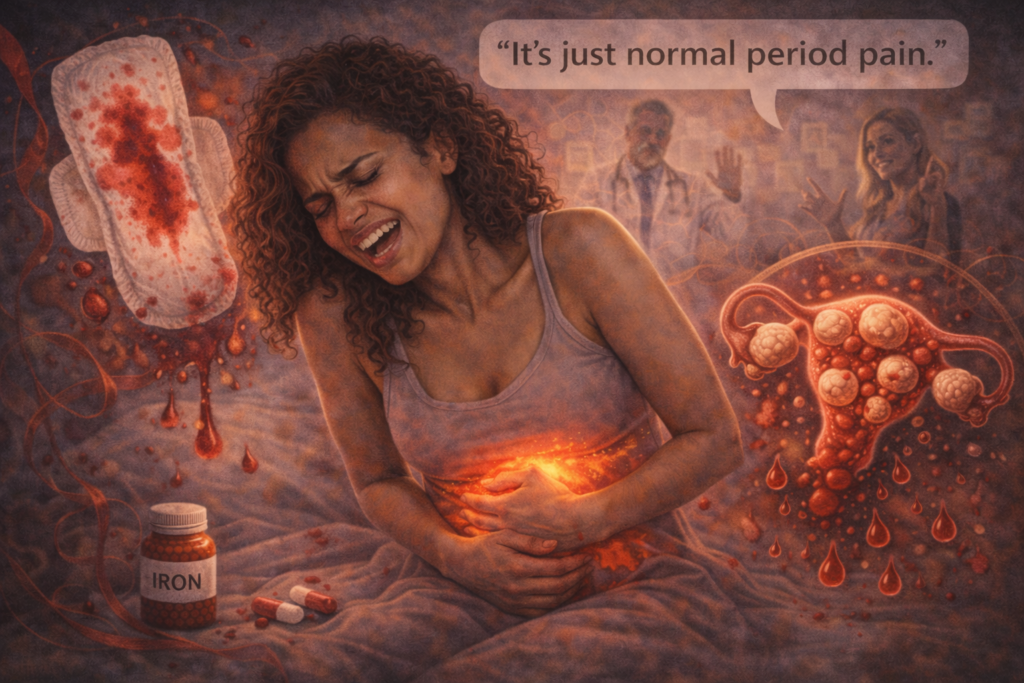
“If you have to plan your life around bleeding, it’s not ‘just a period’ anymore.”
– Wellness Kraft
Introduction
A lot of women don’t wake up one day and think, “My periods are a medical problem.”
It’s usually gradual. The bleeding gets heavier, then heavier again. The cramps get sharper. Fatigue becomes your baseline. You start saying things like:
- “My flow is just strong.”
- “I’ve always had painful periods.”
- “It’s probably stress.”
- “It runs in my family.”
And because you can still function (even if you’re functioning on fumes), you keep going.
But here’s the line nobody says loudly enough:
Heavy bleeding is not a personality trait. It’s a symptom.
Sometimes it’s hormones. Sometimes it’s thyroid issues. Sometimes it’s bleeding disorders. Sometimes it’s endometriosis or adenomyosis. And very often, it’s fibroids.
Fibroids are usually benign growths in or around the uterus, and they can cause:
- heavy or prolonged bleeding
- clots
- cramps and pelvic pressure
- frequent urination or constipation (from “bulk” pressure)
- anemia-related fatigue, dizziness, weakness
- fertility and pregnancy complications for some women
Not everyone with fibroids has symptoms. But when symptoms hit, they can hit hard, and they can quietly steal quality of life.
So if your period feels like a monthly emergency, this post is your “pause and check the facts” moment.
Quick interactive check-in:
When you’re on your period, do you ever feel nervous leaving the house because you’re scared of leaking?
That’s not “normal.” That’s a life impact.
What Heavy Bleeding Really Looks Like (Not the Internet Version)
Heavy bleeding isn’t just “a lot.” It’s when your bleeding changes how you live.
Signs that deserve attention:
- You soak through pads/tampons quickly and regularly
- You need double protection (pad + tampon)
- You pass large clots often
- Your period lasts much longer than it used to
- You feel exhausted, breathless, dizzy, or unusually weak during your period
- You’re waking at night to change protection
- You avoid social plans, travel, workouts, or intimacy because of bleeding
- You’ve had “accidents” that created fear or embarrassment
The emotional part matters too. Many women don’t seek help because they think they’ll be dismissed. Or because they don’t want to seem dramatic. Or because they assume heavy bleeding is just part of being a woman.
It’s not.
Fibroids: The “Quiet Crowding” Problem
Fibroids can be small as a pea or large enough to reshape the uterus. Their location often matters as much as their size.
Here’s why location matters in real life:
- Some fibroids press into the uterine cavity and can trigger heavier bleeding.
- Others grow in the wall of the uterus and contribute to cramping, heaviness, and pressure.
- Some grow outward and mainly cause “bulk symptoms” like pelvic heaviness, urinary frequency, constipation, or back pressure.
When people say “fibroids,” many women imagine one lump. But it can be one or multiple, and symptoms can vary widely.
This is why two women can both have fibroids and have totally different experiences:
- One has mild symptoms and doesn’t even know.
- Another feels like her body is running a monthly marathon with a backpack full of bricks.
A Story You Might Recognize
Danielle is 39. She’s not the type to run to the doctor. She’s the type to adapt.
Her periods started getting heavier in her mid-30s, but she didn’t think much of it. She bought higher-absorbency products. She kept extra underwear in her bag. She started timing errands around her flow.
Then the cramps changed. Not the “ouch, period cramps” kind. The deep, dragging, heavy kind. She began passing clots she didn’t want to talk about out loud. Some days she felt so tired she wondered if she was getting depressed. But the sadness wasn’t emotional. It was physical.
She’d sit on the couch after work and feel like her bones were tired.
One month she was at a grocery store, and she leaked through everything. She left her cart and walked out shaking. Not because of the mess. Because she realized her period had become something she feared.
Still, she waited.
She waited until she was so drained she started getting lightheaded when she stood up fast. She waited until her partner said, “You look pale lately.” She waited until her own body made it impossible to pretend.
When she finally got checked, the conversation wasn’t magical, but it was clarifying. The clinician asked the questions Danielle hadn’t asked herself:
- How often are you soaking through?
- How long does bleeding last?
- Any clots?
- Any pressure symptoms?
- How’s your energy?
- Any shortness of breath or dizziness?
Danielle realized she’d been surviving something she shouldn’t have had to survive.
That’s what fibroids plus heavy bleeding often look like: not a sudden emergency, but a slow takeover.
Why Heavy Bleeding Becomes Dangerous (Even When You “Manage”)
The biggest risk isn’t only inconvenience. It’s what constant blood loss can do to your body over time.
When bleeding is heavy or prolonged, many women develop iron deficiency. And iron deficiency can become anemia. That’s when fatigue stops being “tired” and starts being “I can’t get my life to work.”
What anemia can feel like:
- constant exhaustion, even after sleep
- headaches
- shortness of breath with normal activity
- rapid heartbeat or palpitations
- dizziness
- feeling cold easily
- brain fog
- irritability that feels like you’re “not yourself”
And because women are often expected to push through, they push through anemia too. They normalize it. They drink more coffee. They assume it’s just work stress. Meanwhile, their body is trying to run on low oxygen capacity.
If your period leaves you feeling wiped out for days, that’s not just “being dramatic.” It can be a real biological consequence of real blood loss.
How Fibroids Are Usually Found
Most women don’t get diagnosed from a single sentence. It’s typically a process:
- You describe symptoms
- Your clinician evaluates possible causes
- A pelvic exam might be done
- Imaging is often used to look at the uterus (ultrasound is common)
Sometimes additional tests are done depending on your age, symptoms, and bleeding pattern. The goal is to understand:
- Is this heavy bleeding?
- What’s causing it?
- What’s the best treatment for your goals?
That last part matters a lot. Because treatment isn’t just “remove fibroids.” It’s about your life.
Treatment Options (A Practical, Human Way to Think About It)
Here’s the simplest way to choose a direction without getting overwhelmed:
Step 1: Decide what you want most
Most women want one or more of these:
- less bleeding
- less pain
- better energy
- fewer “accidents”
- preservation of fertility
- avoidance of major surgery
- long-term solution that doesn’t require constant medication
Different treatments fit different priorities.
Step 2: Know the three big lanes
- Symptom-control treatments (reduce bleeding/pain)
- Fibroid-targeted procedures (shrink/remove fibroids)
- Definitive surgery (for women who want a permanent solution and do not desire future pregnancy)
No lane is “best.” The best lane is the one that matches your body, your risk profile, and your plans.
Lane 1: Symptom-control options
These are often used first, especially if symptoms are moderate or if you want to avoid procedures initially.
They may include:
- Non-hormonal medication options that reduce bleeding
- Hormonal options that reduce bleeding and cramps
- A hormonal IUD for many women is a strong option for heavy bleeding, depending on the uterine cavity shape and fibroid location
- Pain management strategies that actually work for you (not just “take a pill and suffer”)
A key point: symptom-control can be life-changing, even if the fibroids remain. For many women, it’s not about eliminating fibroids at all costs. It’s about eliminating the suffering.
Lane 2: Fibroid-targeted procedures
If fibroids are driving symptoms, certain procedures can:
- remove fibroids (sometimes through minimally invasive techniques, depending on size/location)
- shrink fibroids by cutting off blood supply
- use energy to reduce fibroid tissue in selected cases
This lane is where individualized planning matters most. Location, number, size, and fertility goals all shape what’s reasonable.
Lane 3: Definitive solution
For women who have completed childbearing (or don’t want pregnancy) and want a permanent end to fibroid bleeding, definitive surgery may be discussed.
Some women feel instant relief emotionally when they choose a definitive plan. Others want to exhaust other options first. Both are valid. The right choice is the one you can live with peacefully.
What to Say at the Doctor So You’re Taken Seriously
If you’ve been dismissed before, go in with clarity.
Try these phrases:
- “This bleeding is affecting my quality of life.”
- “I’m soaking through protection frequently and it’s limiting my daily activities.”
- “I’m passing clots and my cramps have changed.”
- “I feel fatigued and weak around my periods. Can we check iron levels?”
- “I want to understand whether fibroids could be causing this, and what options fit my goals.”
- “I’m not looking for ‘it’s normal.’ I’m looking for a plan.”
The magic is functional impact. When you describe what you can’t do, the story becomes clinical, not emotional.
When to Seek Help Urgently
There are situations where waiting is not smart:
- very heavy bleeding that makes you feel faint
- symptoms of severe anemia (like significant shortness of breath, chest discomfort, near-fainting)
- severe pelvic pain that comes on suddenly
- bleeding that feels out of control
If your body is telling you “this is too much,” listen.
Research Insight
Clinical guidance recognizes uterine fibroids (leiomyomas) as a common cause of heavy menstrual bleeding and other symptoms like pelvic pressure, while emphasizing individualized management that can include medical therapy, procedures, and surgery depending on symptoms and patient goals. ACOG+2Mayo Clinic+2
Public health guidance also notes that heavy menstrual bleeding can contribute to anemia, which can cause tiredness or weakness, and that heavy bleeding should be evaluated when it affects quality of life. CDC+1
Evidence-based guidelines for heavy menstrual bleeding recommend evaluating the impact on quality of life and considering investigations and treatments based on the likely cause (including fibroids), along with patient preferences. NICE+1
Links (paste as raw URLs in WordPress for auto-clickable sources):
https://www.acog.org/clinical/clinical-guidance/practice-bulletin/articles/2021/06/management-of-symptomatic-uterine-leiomyomas
https://www.cdc.gov/female-blood-disorders/about/heavy-menstrual-bleeding.html
https://www.nice.org.uk/guidance/ng88
https://www.mayoclinic.org/diseases-conditions/uterine-fibroids/symptoms-causes/syc-20354288
https://www.mayoclinic.org/diseases-conditions/uterine-fibroids/diagnosis-treatment/drc-20354294
Key Takeaways
- Heavy bleeding is not “just your flow” if it’s changing your life, your energy, or your ability to function.
- Fibroids are a common reason periods become heavier, longer, and more painful, and they can also cause pressure symptoms.
- The quiet danger of heavy bleeding is iron deficiency and anemia, which can look like constant exhaustion and weakness.
- Treatment isn’t one-size-fits-all: symptom-control options, fibroid-targeted procedures, and definitive solutions all exist depending on your goals.
- The most powerful shift is moving from “tolerating” to “getting a plan.”
FAQs
1) How do I know if my bleeding is “heavy enough” to see a doctor?
If you’re soaking through protection frequently, passing large clots, bleeding longer than you used to, waking at night to change, or changing your routine because of fear of leaking, it’s heavy enough. The moment your period starts controlling your schedule, it deserves evaluation.
2) Can fibroids cause anemia even if I’m “used to” my periods?
Yes. Your body can adapt to a lot, but that doesn’t mean it’s safe. Ongoing heavy bleeding can drain iron stores over time. Many women don’t realize they’re iron deficient until fatigue becomes severe, hair feels thinner, or they start getting dizzy.
3) Do fibroids always need surgery?
No. Many women manage symptoms with medications or hormonal options, and some fibroids don’t cause symptoms at all. Surgery or procedures are usually discussed when symptoms are severe, persistent, or when fibroids interfere with fertility goals or quality of life.
4) Why do my cramps feel worse with fibroids?
Fibroids can change how the uterus contracts and can create inflammation or pressure, which may increase cramping. Some women describe it as “heavier” pain, a deep pelvic ache, or a dragging pressure rather than typical cramps.
5) What’s one test I should ask for if I’m bleeding heavily and exhausted?
Ask to check your iron status. Many women focus only on stopping the bleeding and forget the aftermath: low iron can keep you feeling awful even after bleeding improves. Treating the cause and rebuilding iron stores often works best together.
Concluding Thoughts
Heavy bleeding has a way of turning you into a planner of emergencies. You learn routes, bathrooms, backup clothes, excuses. You become “prepared,” but inside you’re living with fear and fatigue.
You don’t need to live that way.
Whether it’s fibroids or another cause, your body is asking for attention, not endurance. Get evaluated. Ask for a plan. Aim for a life where your period is a chapter, not the whole plot.




Join the conversation