
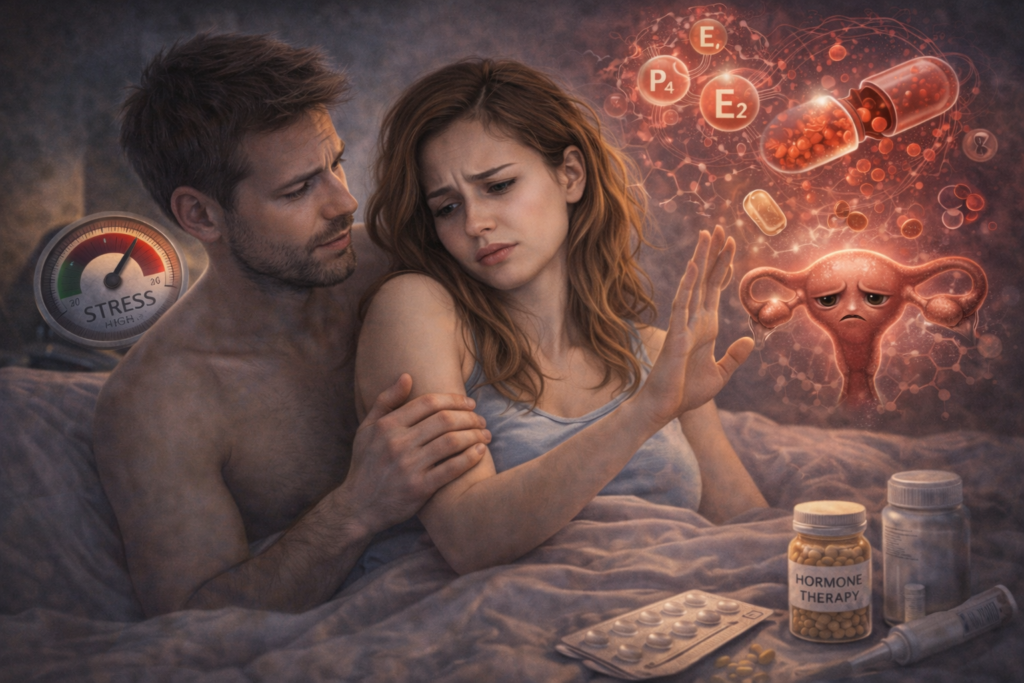
“Desire doesn’t disappear. It goes into hiding when life stops feeling safe.”
– Wellness Kraft
Introduction
There’s a particular kind of loneliness that happens when your body doesn’t want what your heart wants.
You love your partner. You want to feel close. You miss the spark. You miss the version of yourself that used to respond naturally, easily, without a mental checklist running in the background like a noisy fan.
But lately, you don’t feel that pull. Or you think it rarely. Or you feel it only once you’re already in the moment, and even then, it’s fragile, like it might vanish if you think too hard.
And because we live in a world that talks about libido like it’s a switch, you start panicking.
You ask:
Why am I like this?
Is something wrong with me?
Is this hormones? Stress? Age?
What if it never comes back?
What if my relationship suffers?
What if my partner thinks I don’t want them?
First, let’s take the blame off your shoulders.
Low libido in women is common. Desire is not a constant. It’s not proof of love. It’s not a moral score. It’s a response that depends on context: your nervous system, your hormones, your energy, your relationship climate, and whether your body feels safe enough to want anything at all.
The most helpful reframe is this:
Low libido is often a messenger. Not an enemy.
It’s your mind-body saying, “Something here is draining me, distracting me, hurting me, or shutting me down.”
And once you treat the root, desire often returns. Not always as fireworks, but as something real and steady. Something that feels like you again.
Before we go deeper, a gentle interactive check-in (answer honestly, no judgment):
When you think about sex lately, what shows up first?
Excitement? Neutrality? Anxiety? Pressure? Exhaustion? Pain? Resentment? Numbness?
That first feeling is a clue. It tells you whether biology, emotions, environment, or all three block your libido.
What Low Libido Actually Means (And When It’s a Problem)
Libido can dip for normal reasons: a stressful month, a new baby, grief, a medication change, a relationship rough patch, a demanding job, perimenopause shifts, or body image struggles.
A dip becomes a “problem” when it causes distress for you or creates ongoing relationship strain you want to fix. The keyword is want. Not what society expects. Not what someone else pressures you into. What you genuinely want for your own life.
Also, low libido doesn’t always mean “never wants sex.” Sometimes it looks like:
- You rarely initiate, but you might enjoy it once it starts
- You love affection but don’t want intercourse
- You want emotional closeness more than sexual activity
- Your mind wants sex, but your body doesn’t respond
- You’re attracted to your partner, but you feel too depleted to access desire
All of those are real. None of them means you’re broken.
Lauren’s “I Love You, But I’m Not There” Season
Let’s talk about Lauren, 37, a project manager in Austin.
Lauren loves her husband, Ethan. They have a good relationship. They laugh. They’re kind to each other. On weekends, they’re best friends.
But for the last year, their sex life has quietly faded.
Not because Ethan is doing something terrible. Not because Lauren isn’t attracted to him. Not because she suddenly became “cold.”
It’s because Lauren is carrying a life that doesn’t leave room for desire.
Her days are packed with meetings, deadlines, and constant mental switching. Her evenings are household logistics. Groceries. Dinner. Scheduling. Remembering. Following up and worrying about her aging dad, trying to keep her health in check, and trying not to fall behind at work.
At night, Lauren doesn’t feel romantic. She feels wrung out.
Ethan tries to initiate. Lauren tenses up. Not because she hates him, but because she feels pressure. The pressure says, “You should want this.” And “should” is not sexy.
She tries to push through, but her body isn’t responding. Lubrication is lower than before. She feels discomfort sometimes. Then her brain starts anticipating discomfort, so she wants it even less. Now intimacy feels like a performance she’s failing.
Lauren starts avoiding situations that might lead to sex. She stays busy. She scrolls. She falls asleep early. She picks small fights over nothing because underneath, she’s scared and ashamed.
One night, Ethan asks gently, “Did I do something wrong?”
Lauren tears up because the truth is messy:
“I love you. I want us. I just… don’t feel like myself. I don’t feel in my body. I feel like a brain on legs.”
This is where a lot of couples get stuck. They treat it as a motivation or attraction issue, when it’s often a system issue.
Lauren’s desire didn’t disappear. It got crowded out.
Once they approached it differently (less blame, more curiosity), they uncovered the real mix:
- chronic stress and sleep debt
- resentment from carrying most of the mental load
- Mild pelvic discomfort, Lauren never addressed
- anxiety about “not being enough.”
- No space for pleasure during the day, so night became too heavy
When they started fixing those pieces, libido didn’t return as it did in a movie scene. It returned like a slow spring. Small signs. Warmth. Curiosity. More touch. More ease. More yes.
The Big Three Causes: Stress, Hormones, and “Everything Else”
Low libido is rarely one single thing. It’s usually a combination. Here are the standard buckets.
1) Stress and nervous system overload
Stress is a desire killer because desire is not a “survival mode” function.
When your body is in fight-or-flight:
- Cortisol runs high
- sleep suffers
- patience shrinks
- The body prioritizes safety over pleasure
- touch can start feeling like another demand
And modern stress isn’t just emergencies. It’s constant background pressure: notifications, finances, deadlines, caregiving, social expectations, and the mental load of remembering everything.
If your brain feels hunted, your body doesn’t feel playful.
2) Hormone shifts
Hormones can influence:
- desire
- lubrication
- comfort and pain
- arousal response
- mood and energy
Everyday life stages where libido shifts:
- postpartum and breastfeeding
- perimenopause and menopause
- after stopping/starting hormonal contraception
- thyroid changes
- PCOS or metabolic shifts
- after surgeries affecting the ovaries/uterus
- certain medical conditions
Important: hormones are often part of the story, but not the whole story. Many women with “normal labs” still struggle because stress, relationship climate, sleep, and pain are doing the real damage.
3) The “everything else” that matters more than people admit
This is the list that changes everything when you finally take it seriously:
Pain
If sex hurts (even mildly), libido often drops because your body learns to associate intimacy with discomfort. Pain can come from dryness, infections, pelvic floor tension, endometriosis, vaginismus, postpartum changes, and more.
Medications
Common culprits include certain antidepressants, blood pressure meds, and others. (Never stop meds suddenly. This is a “talk to your clinician” category.)
Relationship climate
Desire struggles in cold environments. If there’s resentment, emotional distance, lack of safety, criticism, or unresolved conflict, libido often goes quiet.
Body image and self-consciousness
If you don’t feel good in your body, being seen can feel stressful rather than intimate.
Mental load
If your brain is running household operations like a full-time manager, your body rarely flips into pleasure mode at 10:30 PM.
Depression and anxiety
Both can dampen desire directly and indirectly through low energy, sleep problems, and avoidance.
Trauma history
Past experiences can shape how safe intimacy feels, even in a loving relationship.
The Two Types of Desire (This Explains So Much)
A lot of women assume desire should appear first, like a spark that starts everything. But many women experience desire differently.
One kind is spontaneous desire: you want sex out of nowhere.
Another common kind is responsive desire: you don’t feel desire until you feel safe, connected, relaxed, and already in a pleasurable context.
Responsive desire is normal.
If you’re waiting for a spark to appear before intimacy magically, you might keep concluding “I never want it,” when the truth is: you need the right conditions to want it.
That’s not a flaw. That’s how many bodies work.
So instead of asking, “Why don’t I crave sex?” ask:
“What conditions help my body open up?”
What Treatment Options Actually Look Like (Realistic, Not Fantasy Advice)
Treatment is rarely just a pill. It’s usually a layered approach. Think of it like rebuilding a garden: you don’t just blame the plant, you adjust the soil, sunlight, water, and pests.
Step 1: Rule out physical discomfort and treat pain first
If there’s dryness, burning, tearing, recurrent infections, pelvic pain, or pain with penetration, address that first.
Why? Because a body in pain doesn’t want more pain.
This might involve:
- medical evaluation
- pelvic floor physical therapy
- treating infections or inflammation
- addressing dryness and menopausal changes
- changing lubricants/products that irritate
- slower arousal and more foreplay focused on comfort
Step 2: Check the “libido thieves”
Do a calm audit:
- How’s my sleep?
- How’s my stress level?
- Am I burnt out?
- Do I feel emotionally connected?
- Do I feel pressured?
- Do I feel safe and respected?
- Are there medications that might contribute?
This isn’t about blaming yourself. It’s about identifying what’s draining you.
Step 3: Relationship repair and communication (the unglamorous miracle)
Many couples talk about sex only when it’s already a problem, which makes every conversation feel like pressure.
Try shifting to language like:
- “I miss feeling close to you.”
- “I want to rebuild ease, not force performance.”
- “Can we focus on touch and connection without making it about intercourse?”
- “Can we create no-pressure intimacy nights?”
Sometimes libido returns when the pressure is off.
Step 4: Sex therapy or counseling
This can be highly effective, especially when:
- Anxiety is present
- Trauma history is involved
- Relationship patterns are keeping desire down
- Shame and fear are driving avoidance
A good therapist doesn’t “tell you to have more sex.” They help you build safety, reduce pressure, communicate better, and rebuild pleasure.
Step 5: Medical options (when appropriate)
There are medical treatments used in certain situations, and they should be discussed with a qualified clinician who understands women’s sexual health.
These may include:
- adjusting medications that affect libido
- hormone-related treatments when relevant
- FDA-approved medications for specific diagnoses and populations
- carefully monitored off-label approaches in some cases
This is the part where professional guidance matters most because benefits and side effects vary, and what’s safe for one person might not be safe for another.
A practical “Tonight” plan (for women who feel stuck right now)
If libido feels like a heavy topic, start smaller than sex.
Try one of these low-pressure options:
- 10 minutes of non-sexual touch (no goal, no escalation)
- shower together and talk about anything except sex
- cuddle with the rule: “We are not required to do more.”
- a short walk holding hands
- a “connection check-in”: “What stressed you today? What helped you today?”
Desire often returns through closeness, not through pressure.
Research Insight
Low libido (low sexual desire) in women is widely recognized as common and usually multifactorial, involving a mix of biological factors (hormones, menopause changes, medical conditions, pain), psychological factors (stress, anxiety, depression), relationship factors (conflict, emotional distance), and medication effects. Clinical guidance emphasizes that low desire is considered a disorder only when it causes significant distress or relationship difficulty and persists over time, and that treatment often works best as a combined approach: education, counseling/sex therapy, addressing pain and vaginal discomfort, lifestyle and stress management, and, in some cases, medications or hormone-related therapies. NCBI+4ACOG+4Mayo Clinic+4
Some evidence-based medical options used for specific situations include flibanserin (Addyi) for certain women diagnosed with hypoactive sexual desire disorder, and bremelanotide (Vyleesi) as an as-needed option for certain premenopausal women, both requiring medical screening and discussion of safety and side effects. FDA Access Data+3FDA Access Data+3FDA Access Data+3
For postmenopausal changes, genitourinary syndrome of menopause (vaginal dryness, discomfort, pain) can strongly affect sexual comfort and function, and treating vaginal symptoms can improve sexual well-being for many women. PMC+2Menopause Australia+2
Links (paste as raw URLs in WordPress to auto-link):
- https://www.acog.org/clinical/clinical-guidance/practice-bulletin/articles/2019/07/female-sexual-dysfunction
- https://www.mayoclinic.org/diseases-conditions/low-sex-drive-in-women/diagnosis-treatment/drc-20374561
- https://my.clevelandclinic.org/health/diseases/15216-low-libido-low-sex-drive
- https://www.accessdata.fda.gov/drugsatfda_docs/label/2015/022526lbl.pdf
- https://www.accessdata.fda.gov/drugsatfda_docs/label/2019/210557s000lbl.pdf
- https://www.isswsh.org/resources/publications/405-international-society-for-the-study-of-women-s-sexual-health-clinical-practice-guideline-for-the-use-of-systemic-testosterone-for-hypoactive-sexual-desire-disorder-in-women
- https://pmc.ncbi.nlm.nih.gov/articles/PMC6780739/
Key Takeaways
- Low libido is usually a combination of stress, hormones, pain, relationship climate, mental load, sleep, and sometimes medications.
- Desire often needs safety and ease. Pressure and shame almost always make it worse.
- If sex is painful, treat pain first. A body doesn’t crave what hurts.
- Many women have responsive desire, meaning desire can appear after relaxation, connection, and pleasurable touch begin.
- The most effective treatment is often layered: medical evaluation + stress support + relationship communication + (sometimes) targeted medical options.
FAQs
1) How do I know if my low libido is “normal” or something medical?
If it’s temporary, not distressing, and linked to a life season (stress, new baby, grief, exhaustion), it may be a regular dip. If it’s persistent, distressing, affecting your relationship, or linked to pain, dryness, or other symptoms, it’s worth a medical check. A helpful guiding question is: “Is this bothering me enough that I want help?” If yes, that’s reason enough to talk to a clinician.
2) Can stress really shut down desire that much?
Yes. Stress isn’t just a feeling; it’s a bodily state. When your nervous system is in high alert, your body prioritizes survival and reduces pleasure-driven functions. Also, stress steals the mental bandwidth needed for desire: presence, relaxation, and openness. Many women don’t lose libido because they “don’t love their partner,” they lose libido because their body is exhausted and their brain is overloaded.
3) What if I love my partner but feel irritated when they initiate?
That irritation is often pressure in disguise. Your body might be hearing: “Here’s another expectation I have to meet.” Or it might be anticipating discomfort, guilt, or conflict. The fix is usually not “force yourself.” The fix is rebuilding safety: no-pressure touch, honest conversations, and addressing the hidden blockers (resentment, mental load imbalance, sleep, pain, anxiety).
4) Are there treatments beyond “try to relax” and “go on a date”?
Yes. A good evaluation can identify treatable causes like vaginal dryness/pain, hormonal shifts, medication effects, thyroid issues, depression/anxiety, pelvic floor tension, and more. Treatments can include pelvic floor therapy, targeted vaginal treatments, counseling/sex therapy, medication adjustments, and, in some cases, specific prescription options. The “best” approach is individualized because low libido isn’t one-size-fits-all.
5) What’s one small thing I can do this week that actually helps?
Pick one:
- Improve sleep by 30 minutes for 5 nights (sleep is libido’s best friend).
- Have a no-pressure intimacy agreement: touch without expectation.
- Reduce mental load by delegating one recurring task (one less thing in your brain).
- Schedule 15 minutes of pleasure that isn’t sexual: music, bath, walk, or reading.
Desire grows in a life that has breathing room.
Concluding Thoughts
Low libido can feel personal, like your body is betraying you or your relationship is failing. But most of the time, it’s not a character flaw. It’s a signal.
A signal that you’re tired. That you’re stressed. That you’re carrying too much. That your body doesn’t feel safe. That intimacy has pressure attached. That something hurts. That something needs attention.
And here’s the hopeful part: signals can be answered.
Start with curiosity, not shame.
Start with comfort, not performance.
Start with the root, not the guilt.
Libido isn’t something you force. It’s something you invite back, gently, by making your life and your relationship a place where your body wants to return.




Join the conversation